By Shahzad Mukhtiar | Real Estate Guide | Updated October 18, 2026
Selling a property can become challenging when buyers are cautious, mortgage costs are high, and competing homes remain on the market for weeks or months. However, a slow housing market does not mean that every property must sell at a substantial discount. Sellers who understand local demand, present their homes effectively, and negotiate intelligently can improve their chances of attracting serious buyers.
When high interest rates or broader economic shifts slow buyer demand, listing a property requires a refined approach. Successfully selling in a buyer’s market depends on precise pricing, strategic positioning, and legal clarity.
This guide explains how to sell your home in a slow market using practical pricing methods, modern real estate marketing, legal preparation, buyer incentives and international market insights. Whether you own a house in the United States, Canada, the United Kingdom, Germany, India or Pakistan, the objective is to make your property competitive while protecting your financial interests.
How to sell your home in a slow market?
How to sell your home in a slow market comes down to five priorities: realistic pricing, excellent presentation, targeted marketing, flexible negotiations, and legally prepared paperwork. Start by comparing recently sold properties in your neighborhood rather than relying on sellers’ asking prices. Repair visible defects, declutter rooms, use professional photographs, and advertise the features buyers value most.
Offer reasonable closing-cost assistance or flexible completion dates when appropriate. Monitor viewing requests and buyer feedback, then adjust your strategy if interest remains weak. Across slower housing markets, including parts of Canada, the United Kingdom, Germany, and the United States, informed pricing and preparation can help sellers compete without automatically accepting a low offer.
What is a slow real estate market?
A slow real estate market is a period when properties take longer to sell, buyer demand weakens, or available homes outnumber the buyers actively looking to purchase them. Sellers may receive fewer inquiries, face more negotiations or need to adjust their asking prices.
Several factors can contribute to a housing slowdown:
- High mortgage interest rates that reduce buyers’ purchasing power.
- Economic uncertainty and concerns about employment.
- An increase in competing property listings.
- House prices that exceed what local buyers can comfortably afford.
- Stricter mortgage approval requirements.
- Property condition, location or documentation problems.
A slow market is not necessarily a housing crash. Some neighborhoods continue to attract buyers because of employment opportunities, schools, transport links or limited housing supply.
Example: A well-maintained family home near a major employment center may sell relatively quickly even when expensive properties elsewhere in the same city remain unsold.
15 proven strategies for selling a home in a slow market
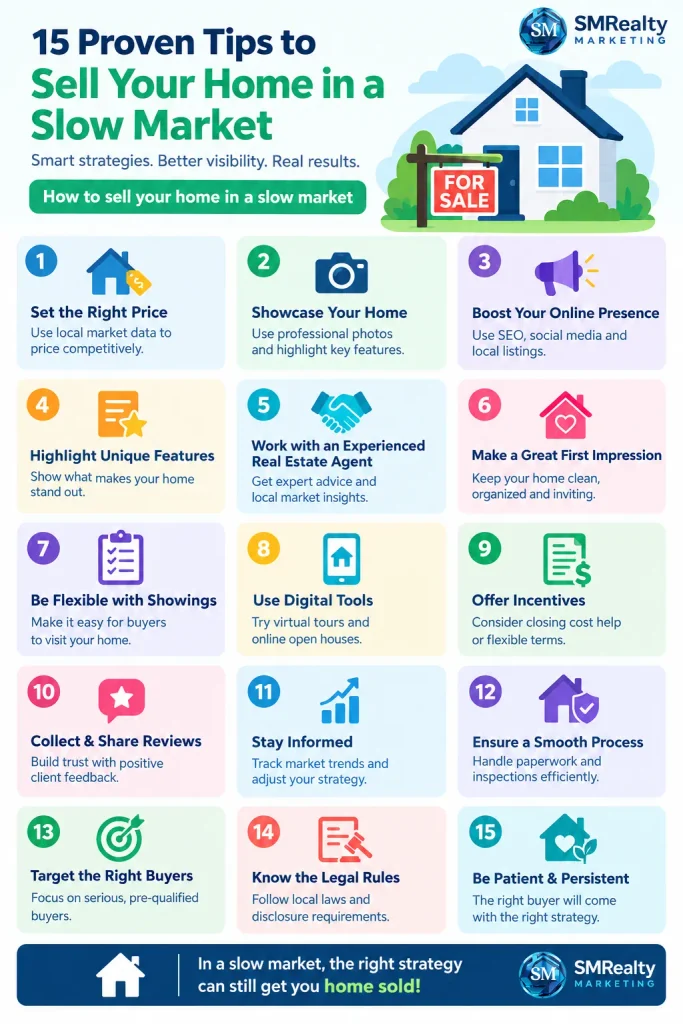
15 Proven Tips to Sell Your Home in a Slow Market
1. Price your property according to current market evidence
Pricing is one of the most important decisions when selling a house in a buyer’s market. An asking price based on emotional attachment, renovation expenses or last year’s peak prices may discourage potential buyers.
Start by examining comparable properties, commonly called comps. Look for homes with similar:
- Location and neighborhood characteristics.
- Size, layout and land area.
- Age, condition and construction quality.
- Parking, outdoor space and amenities.
- Recent completed sale prices.
Give greater weight to recent transactions and adjust for meaningful differences between properties. In a rapidly changing market, older sales may not reflect today’s buyer demand.
Example: Suppose comparable homes recently sold for $300,000, $310,000 and $320,000. Their simple average is $310,000. If your property has an older kitchen and needs roof repairs, an asking price of $310,000 may not be competitive without accounting for those defects.
This is an illustrative example, not a universal valuation formula. A local estate agent or qualified appraiser can help establish an appropriate range.
2. Study competing listings before choosing your asking price
Recent sales tell you what buyers have paid, while active listings show the alternatives they can choose today.
Compare at least five relevant competing properties, if available. Record their asking prices, condition, days on market, price reductions and distinctive features.
| Comparison factor | What to investigate |
|---|---|
| Asking price | Is your home more expensive than similar properties? |
| Property condition | Do competitors offer better kitchens, bathrooms or maintenance? |
| Marketing | Do their listings include professional photographs and floor plans? |
| Time on market | Are similar properties also struggling to sell? |
| Buyer incentives | Are competing sellers offering repairs, warranties or closing assistance? |
Avoid copying a competitor’s asking price without checking whether that property is realistically priced. An overpriced listing is not reliable evidence of market value.
3. Improve curb appeal before taking photographs
First impressions influence whether buyers schedule a viewing. A property that appears neglected from the street may be rejected before potential buyers see its interior.
Focus on affordable improvements first:
- Mow the lawn and trim shrubs.
- Clean the entrance, driveway and windows.
- Repair loose handles, gates and exterior lights.
- Remove rubbish and unnecessary outdoor items.
- Refresh worn paint where practical.
- Make the entrance welcoming and easy to access.
Do not spend heavily on landscaping or cosmetic improvements without considering your expected sale price and local buyer preferences.
4. Stage your home to help buyers imagine living there
Home staging involves arranging a property to make its space, natural light and useful features more apparent.
In a slow market, buyers often compare several homes before making an offer. Clean, uncluttered rooms help them assess the property’s potential.
Consider the following:
- Remove excess furniture that makes rooms look smaller.
- Store personal photographs and highly distinctive decorations.
- Deep-clean kitchens, bathrooms and floors.
- Open curtains and replace failed light bulbs.
- Repair dripping taps, damaged doors and loose fittings.
- Keep bedrooms and living areas arranged for their intended use.
A professional staging service may be worthwhile for higher-value properties, but careful decluttering and cleaning can also improve presentation on a limited budget.
5. Invest in professional photography and virtual tours
Most buyers begin their search online. Poor photographs can prevent them from arranging a viewing, even if the property itself is attractive.
A strong property listing should include:
- Bright, accurately exposed photographs.
- A clear image of the property’s exterior.
- Useful views of the kitchen, bedrooms and bathrooms.
- Floor plans with measurements where appropriate.
- A virtual tour or video walkthrough when practical.
- Accurate information about the neighborhood and amenities.
Avoid misleading wide-angle photographs, digitally removing defects or exaggerating room sizes. Honest marketing attracts better-informed buyers and reduces the risk of disputes later.
6. Advertise where your target buyers actually search
Publishing a listing on one property website may not reach every suitable buyer. Choose channels based on the property type and likely audience.
| Marketing channel | Potential benefit |
|---|---|
| Local property portals | Reach active buyers searching within the area |
| Estate agent networks | Connect with buyers already registered with agents |
| Social media advertising | Reach selected local audiences |
| Email lists | Notify buyers looking for similar properties |
| Open houses | Allow multiple prospective buyers to view the property |
| Relocation networks | Reach employees and families moving for work |
| International property portals | Potentially reach overseas buyers for suitable properties |
| Google My Business Profile (GMB) | The most reliable and customise local Selling Platform. |
In Pakistan, for example, sellers may consider established property portals such as Zameen.com alongside reputable local agents. In the UK, estate agency websites and portals such as Rightmove may be relevant. The best channels depend on local practices, listing costs and your intended buyers.
Measure results rather than assuming that more advertising always produces more serious inquiries.
7. Highlight features that solve buyers’ problems
A property description should explain why the home is useful to its likely buyer, rather than simply describing it as beautiful or luxurious.
For a family home, emphasize practical layout, storage, schools and transport access. For a smaller urban property, highlight commute times, low-maintenance living and nearby services. For an investment property, provide accurate information about rental history and operating expenses where available.
Use verifiable claims. Do not promise guaranteed rental income, future appreciation or uninterrupted access to amenities unless the claim is properly supported.
8. Offer buyer incentives before making a large price reduction
Some buyers are interested in a property but face financial barriers at closing. A carefully structured incentive may help address those concerns.
Possible incentives include:
- A contribution toward eligible closing costs.
- A repair allowance agreed in writing.
- Including selected appliances or fixtures.
- A home warranty where available.
- A flexible completion date.
- Mortgage-rate assistance where lawful and available through an appropriate lender.
Consider this simplified example:
| Option | Seller’s illustrative cost |
|---|---|
| Reduce a $400,000 asking price by 2% | $8,000 |
| Offer a $4,000 closing-cost contribution | $4,000 |
| Difference in initial cost | $4,000 |
The concession may cost less, but it will not necessarily attract more buyers than a lower asking price. Eligibility, lender limits, local rules and buyer preferences all matter. Compare the likely net proceeds and ask a qualified professional to confirm the terms.
9. Make showings convenient
A buyer who cannot arrange a viewing may move on to another property.
Where practical, offer appointments during evenings or weekends, keep the home ready for viewings, and respond promptly to inquiries. Provide clear access instructions and coordinate with occupants.
If the property is rented, review the tenancy agreement and applicable notice and access requirements before arranging visits. Respecting tenants’ legal rights is essential.
10. Select an estate agent with a relevant local track record
A familiar brand does not automatically make an agent the best choice for your property.
Interview at least two or three suitable agents and ask:
- How many similar properties have you sold recently?
- What evidence supports your proposed asking price?
- Which marketing channels will you use?
- How frequently will you provide updates?
- What are your commission, contract and cancellation terms?
- How will you qualify prospective buyers?
Request a written marketing plan and agree on how performance will be reviewed.
If your existing agent has not generated meaningful interest, first examine the pricing, photographs, advertising and viewing arrangements. Switching agents may help, but it is not a substitute for correcting a weak sales strategy.
11. Respond to feedback with a measurable plan
Buyer feedback can reveal problems that sellers overlook.
If viewers consistently mention a dark living room, outdated bathroom or excessive asking price, investigate whether the criticism is supported by competing listings and market evidence.
Use this simple decision framework:
- Very few online inquiries: Review pricing, listing visibility and photographs.
- Many inquiries but few viewings: Improve the description, qualification process or scheduling.
- Many viewings but no offers: Investigate price, condition and buyer objections.
- Offers repeatedly fail: Review financing, valuation, title documentation and contract conditions.
Set a review date before launching the listing. For example, after 14–21 days, assess actual inquiries, viewings and comparable sales. This is a proposed management schedule, not a universal rule about how quickly a home should sell.
12. Negotiate offers using net proceeds, not just the headline price
The highest offer is not always the best offer. Financing uncertainty, inspection findings, contingencies and completion timing can affect the likelihood of a successful transaction.
Compare each offer using the following:
| Factor | Questions to ask |
|---|---|
| Offer price | How does it compare with market evidence? |
| Financing | Has the buyer demonstrated credible funding? |
| Conditions | Are there inspection, mortgage or sale-of-property contingencies? |
| Closing date | Does it fit your plans? |
| Requested repairs | What additional cost or risk could arise? |
| Deposit | Does it meet local requirements and contract terms? |
Seek qualified legal or estate agency advice when interpreting contractual conditions. Do not assume a cash offer is automatically safe or that a financed offer is necessarily weak.
13. Prepare the legal paperwork before accepting an offer
Documentation problems can delay a transaction or cause it to collapse. Requirements vary significantly by country, state, province and property type.
Common documents or checks may include:
- Evidence of ownership and title.
- Identification and authority to sell.
- Mortgage payoff or lien information.
- Required property disclosures.
- Building permits and approved alterations, where relevant.
- Tax, utility or service-charge records.
- Tenancy agreements for occupied investment properties.
- Sale agreement and completion documentation.
International legal considerations
- United States: State and local rules govern disclosures, escrow, title and closing procedures. Federal law also restricts certain discriminatory housing practices.
- United Kingdom: Conveyancing requirements, title checks, property information forms and other disclosures depend on the jurisdiction and transaction.
- Canada: Provincial and territorial rules govern many aspects of disclosure, contracts and closing.
- Germany: Residential property transfers generally require notarization, with land-register requirements relevant to ownership transfer.
- Pakistan: Title verification, applicable registration and transfer procedures, taxes, authority approvals and any society-specific requirements should be checked with a qualified local property lawyer.
14. Calculate your minimum acceptable net proceeds
Before negotiating, estimate what you will actually receive after the sale.
Illustrative example
| Item | Amount |
|---|---|
| Agreed sale price | $350,000 |
| Agent commission and selling fees | −$17,500 |
| Repairs and agreed concessions | −$5,000 |
| Mortgage payoff | −$200,000 |
| Estimated amount remaining | $127,500 |
This example excludes any additional taxes, legal charges, early repayment fees and other transaction-specific expenses. The actual amount could differ considerably.
The key lesson is to evaluate offers against your financial needs and holding costs, not simply the original purchase price or hoped-for profit.
15. Consider alternatives if a conventional sale is not working
If the property continues to attract little interest, review whether a different transaction method is suitable.
Options may include:
- A private sale, where lawful and properly documented.
- A cash buyer or investor.
- An auction through a reputable provider.
- Renting the property temporarily.
- Making targeted repairs before relisting.
- Pausing the sale if your finances and circumstances permit.
Each option has trade-offs. Cash buyers may offer speed and convenience but seek a discount. Auctions may create competition but do not guarantee a desirable price. Renting introduces landlord responsibilities, maintenance costs and potential future selling complications.
Choose an option based on verified costs, legal obligations and your need for certainty.
A Practical 30-Day How To Sell Your Home In A Slow Market Action Plan
Days 1–7: Research and preparation
- Review recent comparable sales and active listings.
- Obtain a realistic valuation range.
- Check title documents and estimated selling costs.
- Complete essential cleaning and repairs.
Days 8–14: Launch the listing
- Take accurate, high-quality photographs.
- Publish a detailed property description.
- Activate relevant portals and agent networks.
- Make viewing arrangements convenient.
Days 15–21: Evaluate market response
- Count inquiries and completed viewings.
- Record objections and questions.
- Compare competing listings and price changes.
- Decide whether the problem is price, presentation or exposure.
Days 22–30: Refine and negotiate
- Make evidence-based adjustments.
- Consider appropriate buyer incentives.
- Evaluate offers by net proceeds and reliability.
- Confirm legal documents and completion requirements.
This timetable is a framework for taking action, not a promise that every property will sell within 30 days.
Author’s thoughts: what really makes a difference?
In my view, the biggest mistake sellers make in a slow housing market is treating the asking price as a statement of what their home is worth rather than a decision about how to compete.
Buyers compare alternatives. They consider monthly mortgage payments, repair costs, location, future expenses and the risk of overpaying. A seller who understands these concerns can respond with better pricing, stronger presentation and more useful information.
A Google Business Profile can help real estate agents attract potential home sellers and buyers in a slow market, particularly when people search for local estate agents, property agents, or real estate services.
However, selling quickly should not become the only objective. A rushed transaction with unfavorable terms, unreliable financing or unresolved legal issues can be more costly than a longer marketing period.
My recommendation is to establish three figures before listing: a realistic market-value range, an acceptable net-proceeds target and a minimum price that makes financial sense after considering your circumstances. Review them with a qualified local professional and use actual buyer feedback to guide decisions.
Conclusion :How To Sell Your Home In a Slow Market?
Learning how to sell your home in a slow market requires more than lowering the asking price. It involves understanding local housing conditions, pricing against genuine comparable sales, improving presentation, reaching the right buyers and negotiating carefully.
Global examples from Canada, the UK, Germany, Dubai, Pakistan and the United States demonstrate that housing conditions vary by city and over time. Even within a slower market, a well-presented property with accurate pricing and clear documentation may attract suitable buyers.
Start with market research, prepare the property, launch a credible marketing campaign and establish a review schedule. Make adjustments based on evidence rather than fear or wishful thinking. Most importantly, protect your legal position and calculate the net proceeds before committing to a sale.
Frequently Asked Questions (FAQs)
1. How do I sell my home in a slow market?
Research recent comparable sales, set a competitive asking price, improve the property’s presentation, use quality photographs, advertise across relevant channels and make viewings convenient. Review buyer feedback and negotiate based on your financial objectives.
2. Should I lower my asking price if my home is not selling?
Not automatically. First examine the number of inquiries, viewings, buyer objections and competing properties. If the evidence indicates that your price exceeds current market expectations, a well-calculated reduction may be more effective than continuing with an unrealistic asking price.
3. How long should I wait before reducing my house price?
There is no universal deadline. Agree on a review point before listing, perhaps after two or three weeks, and assess the quality of inquiries, viewings and offers alongside local market activity.
4. Can I sell my house without making expensive renovations?
Yes. Focus on cleaning, decluttering, minor repairs, lighting and curb appeal. Address serious defects honestly, but avoid costly renovations unless reliable market evidence suggests they will improve your net proceeds.
5. Are buyer incentives better than reducing the price?
They can be, particularly when buyers face upfront costs. However, a price reduction may reach a wider group of buyers or improve affordability. Compare the total cost, expected response and applicable lender and legal restrictions before choosing.
6. Should I sell now or wait for the housing market to recover?
Consider your financial position, mortgage costs, maintenance expenses, personal timeline and local market outlook. A recovery is uncertain, and waiting can be expensive. Compare realistic sale proceeds today with the cost and risk of holding the property.
7. What is the best way to market a house in a buyer’s market?
Use accurate pricing, high-quality photographs, a detailed description, appropriate property portals, agent networks and convenient viewings. Emphasize verifiable features that matter to your target buyers.
8. Can a house sell quickly when house prices are falling?
Yes. Individual properties can still attract buyers in a declining market. Location, condition, price, financing availability and local demand all influence the outcome. A general market decline does not mean every property will experience the same result.
9. What legal documents do I need to sell my home?
Common requirements include ownership or title records, identification, relevant disclosures, mortgage and lien information, contracts and transfer documents. The exact list depends on the property’s location, ownership structure and local law. Consult a qualified conveyancer or property Professional.
10. How do I choose between a cash buyer and a traditional buyer?
Compare the net offer, evidence of funds, conditions, completion date and contractual protections. A cash buyer may offer a simpler process, while a traditional buyer may offer a higher price.
11. Does professional home staging guarantee a faster sale?
No. Staging can improve presentation and help buyers understand a property’s layout, but it cannot compensate reliably for unrealistic pricing, weak demand or serious property defects.
12. How can I sell a house in Pakistan during a slow property market?
Research recent transactions in your specific locality, compare per-marla or per-square-yard rates where appropriate, prepare ownership and transfer documents, use reputable property portals and verify prospective buyers.
13. Can Google Business Profile help real estate agents sell homes in a slow market?
Yes, Google Business Profile can help real estate agents attract local buyers and homeowners who are searching for property services during a slow housing market. By maintaining accurate contact details, adding professional photos, publishing relevant updates, and collecting genuine client reviews, agents can strengthen their local online presence and build trust.