Suggested author byline: By Shahzad Mukhtiar | Real Estate Research and Market Insights
Architectural style and interior layout directly influence market value and days-on-market (DOM). While trendy, hyper-specific decor can alienate potential buyers, timeless design principles consistently drive premium valuations.
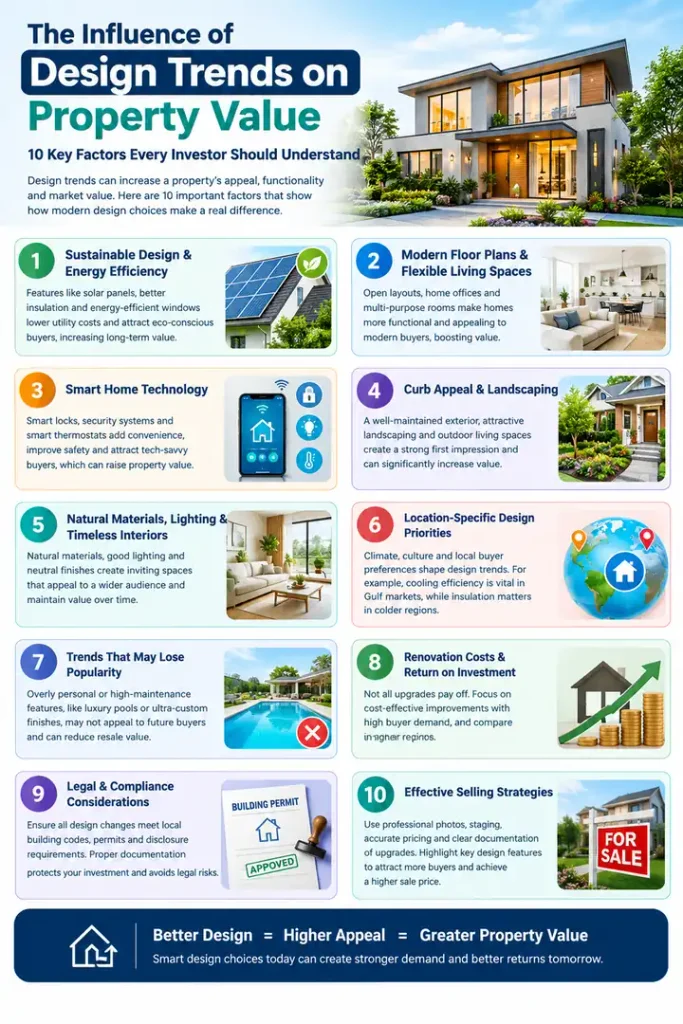
The Influence of Design Trends on Property Value
Property value is influenced by location, construction quality, neighbourhood amenities, market conditions, and the design of a building. While a property’s location remains important, its architectural style, interior layout, exterior appearance, and energy performance can influence how buyers perceive its value.
The influence of design trends on property value has become particularly relevant as buyers consider energy costs, flexible living spaces, modern kitchens, natural lighting, and digital home technology. Developers are also adapting residential projects to changing lifestyles and environmental expectations.
Research from Realtor.com highlights growing interest in energy-efficient features, indoor-outdoor living, and smart-home technology. Meanwhile, Zillow’s 2025 buyer research found that 33% of prospective buyers ranked the floor plan as their most important listing feature, while 26% selected high-resolution photographs
The Influence Of Design Trends on Property Value: 10 Factors Every Investor Should Understand
1. Sustainable Design and Energy Efficiency
Sustainable home design is increasingly relevant to buyers who want lower utility bills, improved comfort, and more efficient use of resources. Features such as insulated walls, efficient windows, water-saving fixtures, shading, and appropriately designed ventilation can make a property more practical.
The National Association of REALTORS® reported in 2025 that 86% of surveyed buyers considered windows, doors, and siding very or somewhat important green features. Its research also found that 72% considered utility bills and operating costs important.
Example: In a hot climate such as Dubai or Karachi, suitable shading, roof insulation, efficient cooling, and solar readiness may appeal to buyers concerned about electricity costs. The financial benefit depends on installation costs, energy prices, building conditions, and local regulations.
Investors should prioritize improvements that provide measurable savings instead of assuming every environmentally friendly feature commands a higher sale price.
2. Modern Floor Plans and Flexible Living Spaces
Functional layouts can influence both buyer interest and a property’s usability. Open-plan kitchens and living areas may create a sense of space, while separate work areas, storage, and flexible bedrooms can support changing household needs.
However, open-plan design is not universally preferred. Some buyers want privacy, quiet rooms, or separation between cooking and living areas. The most effective layout depends on the property’s size, target audience, and local lifestyle.
Example: A two-bedroom apartment in London might benefit more from a well-designed home office and storage than from removing a wall to create a larger living area.
Before changing a floor plan, consult a qualified professional about structural walls, fire safety, ventilation, and permissions.
3. Smart Home Technology and Property Value
Smart locks, security systems, thermostats, lighting controls, and energy-monitoring devices can make properties more convenient and attractive to some buyers.
Zillow’s 2025 research identified security as the leading smart-home priority among buyers who considered smart-home features highly important. It also reported growing importance for smart locks and alarms.
Yet technology can become outdated quickly. Expensive automation systems may not deliver equivalent resale returns if buyers do not value them or if maintenance is difficult.
Recommended approach: Install reliable, widely supported devices, keep controls simple, document warranties, and ensure the property remains usable if internet connectivity fails.
4. Curb Appeal, Landscaping, and Exterior Design
Curb appeal shapes a buyer’s first impression before they enter a property. Exterior paint, a maintained entrance, suitable plants, clean pathways, and effective outdoor lighting can make a home appear better cared for.
Landscaping should reflect local climate and water availability. Drought-tolerant planting may be suitable for arid regions, whereas drainage and moisture-resistant materials may be more important in rainy climates.
Developers can also create value through attractive communal gardens, walkable pathways, shaded outdoor areas, and well-maintained shared spaces. Research published by Australian developer Mirvac in 2025 highlighted buyers’ interest in walkability and nearby community amenities.
5. Natural Materials, Lighting, and Timeless Interiors
Natural wood, stone, neutral finishes, layered lighting, and durable flooring can create interiors that appeal to a broad range of buyers.
Large windows and well-positioned lighting can make rooms feel more welcoming, but glazing should be appropriate for the climate and building orientation. In hot locations, excessive unshaded glass can increase cooling costs.
Highly personalized interiors can work well in luxury properties when they match the intended audience. For ordinary resale properties, however, overly distinctive colours, expensive bespoke finishes, or elaborate decorative features may narrow buyer appeal.
The objective is not to eliminate personality. It is to balance visual character with durability, functionality, and broad market appeal.
6. Design Trends Across International Real Estate Markets
The influence of design trends on property value differs across countries because climate, culture, regulations, income levels, and buyer expectations are not identical.
| Real estate market | Relevant design priorities | Potential value benefit |
|---|---|---|
| United States | Functional kitchens, efficient windows, flexible rooms, security | Broader buyer appeal and improved usability |
| United Kingdom | Space-efficient layouts, insulation, practical storage | Comfort and potentially lower energy costs |
| Australia | Natural light, outdoor living, walkability, climate-responsive design | Better lifestyle appeal |
| Dubai, UAE | Efficient cooling, shading, smart security, sustainable design | Lower operating costs and alignment with buyer preferences |
| Saudi Arabia | Thermal comfort, energy efficiency, water conservation | Practical performance in a hot climate |
| Pakistan | Ventilation, solar readiness, durable finishes, privacy, secure entrances | Improved comfort and relevance to local buyer needs |
These are market-specific considerations, not guarantees of appreciation. The same renovation can perform differently in two neighbourhoods within the same city.
PwC Middle East reported in November 2025 that its survey of more than 2,000 homebuyers in Saudi Arabia and the UAE found an average willingness to pay a 7% premium for homes with sustainable features, while homes without such features were discounted by around 4%. These are survey findings, not guaranteed transaction premiums for every property.
7. Design Trends That May Lose Their Appeal
Not every popular feature becomes a long-term investment advantage. Design trends can decline when maintenance costs increase, lifestyles change, or buyers prefer more practical alternatives.
Realtor.com research comparing listing descriptions from January–September 2024 with the same period in 2025 reported declining mentions of formal dining rooms with built-ins and infinity-edge pools, alongside growth in several efficiency-focused features. This reflects changing listing trends, not definitive proof of falling resale values.
Potentially risky upgrades include:
- Luxury finishes that exceed neighbourhood standards.
- Swimming pools with high maintenance costs and limited local demand.
- Permanent layouts that sacrifice useful bedrooms or storage.
- Highly customized interiors that are expensive to reverse.
- Smart systems with proprietary components or limited support.
Before renovating, compare the planned improvement with recently sold properties in the same price range.
8. Renovation Costs, Return on Investment, and Property Pricing
A design upgrade should be evaluated financially as well as visually.
Use this basic calculation:
Net renovation benefit = Estimated sale-price uplift – Total renovation cost
For example, if a renovation costs $12,000 and credible comparable-sales evidence suggests a possible $15,000 increase in sale price, the estimated net benefit is $3,000 before financing, selling expenses, taxes, and other costs. This is an illustrative scenario, not a predicted market result.
A more complete return calculation is:
ROI = Net gain / Total investment X 100
For a renovation, define net gain consistently. If you measure incremental sale proceeds after renovation costs and other expenses, avoid subtracting the same costs twice.
| Upgrade | Relative cost | What to investigate |
|---|---|---|
| Fresh paint and minor repairs | Low | Buyer perception and presentation |
| Lighting improvements | Low–medium | Room usability and appearance |
| Landscaping and entrance improvements | Low–medium | Local climate and curb appeal |
| Kitchen or bathroom renovation | Medium–high | Comparable sales and scope control |
| Insulation and efficient windows | Medium–high | Energy savings and buyer demand |
| Smart-home systems | Low–high | Compatibility, support, and local preferences |
| Major structural changes | High | Permissions, engineering, and resale evidence |
A property’s current market value should be assessed using comparable sales, condition, location, and relevant market evidence. Renovation costs alone do not establish how much value an improvement adds.
9. Legal Considerations When Updating or Selling a Property
Design improvements must comply with applicable laws and building requirements. A visually impressive renovation can create financial and legal problems if it lacks required approvals or conceals defects.
Homeowners, developers, and sellers should consider the following:
- Planning permission and building permits: Check whether structural changes, extensions, conversions, or changes of use require approval.
- Building and safety standards: Confirm compliance with applicable fire safety, electrical, plumbing, accessibility, and structural requirements.
- Accurate property disclosures: Disclose defects and other material information as required by local law. Do not conceal water damage, unsafe wiring, or unauthorized alterations.
- Energy-performance claims: Support claims about energy savings, certifications, and environmental performance with reliable documentation.
- Ownership and title: Confirm that the person selling the property has the legal authority to do so and that relevant title and registration records are in order.
- Contractor agreements: Use written contracts covering the work, price, schedule, warranties, materials, and responsibility for obtaining permits.
Legal requirements vary by jurisdiction. In England and Wales, for example, sellers should review the applicable property information and disclosure requirements and seek professional conveyancing advice. In the United States, requirements vary by state and municipality. In Pakistan, check the relevant development authority, municipal rules, approved building plans, and applicable provincial or local property laws.
For developers, sustainability certifications and energy-efficiency claims should be verifiable. For buyers, inspection reports and 1. Stage rooms around their intended purpose
approval records can help identify risks before completing a purchase.
10. Selling Strategies That Turn Good Design into Buyer Interest
Design can improve a property’s presentation, but sellers still need to demonstrate value through accurate pricing and credible evidence.
1. Stage rooms around their intended purpose
Arrange furniture to show how buyers can use each space. Keep walkways clear and avoid overcrowding small rooms.
2. Use high-quality photographs and floor plans
Present the layout accurately and show natural light, storage, outdoor areas, and useful improvements. Zillow’s 2025 research identified floor plans and high-resolution photographs among buyers’ most important listing features.
3. Document improvements
Retain invoices, warranties, permits, energy reports, and maintenance records. Specific evidence is more persuasive than unsupported claims that a property is premium or eco-friendly.
4. Price according to comparable sales
Ask a qualified local agent or appraiser to compare similar properties, accounting for location, size, condition, and meaningful differences in design.
How Can Design Trends Increase Property Value?
The influence of design trends on property value depends on how well a property’s appearance, functionality, energy efficiency, and location match buyer demand. Homeowners and real estate investors can improve resale potential by prioritizing practical renovations, sustainable materials, attractive landscaping, flexible layouts, and useful smart-home features. However, fashionable upgrades do not automatically increase a property’s market price.
Before investing, compare similar properties, research local buyer preferences, estimate renovation costs, and calculate the potential return on investment.
The best strategy is to combine timeless design with carefully selected modern features that improve comfort, reduce operating costs, and appeal to the target market.
High-ROI Upgrades vs. Low-ROI Trends
High-ROI Investments:
- Functional Open-Concept Spaces: Removing non-load-bearing walls to create unified kitchen-living environments.
- Energy-Efficient Infrastructure: High-efficiency HVAC units, smart thermostats, upgraded insulation, and dual-pane windows appeal to modern cost-conscious buyers.
- Neutral Modern Finish Kits: Clean cabinetry, durable quartz countertops, and neutral flooring options (such as LVP or refinished hardwood).
Low-ROI / High-Risk Trends:
- Highly customized, bold tile patterns or overly specific accent walls.
- Converting essential garage space or bedrooms into single-use specialty rooms (e.g., dedicated home theaters).
- Over-improving a property far beyond the average standard of the immediate neighborhood.
Recommendations for Homeowners, Investors, and Developers
- Homeowners: Begin with repairs, lighting, paint, storage, and exterior maintenance before committing to major renovations.
- Property investors: Compare expected renovation costs with realistic local resale evidence and rental demand.
- Real estate developers: Integrate energy efficiency, climate-responsive design, flexible spaces, and useful community amenities.
- Real estate agents: Explain documented benefits rather than promising unsupported price premiums.
- Property buyers: Evaluate maintenance costs, building approvals, energy performance, and the quality of construction alongside appearance.
Author’s Thoughts: Should Investors Follow Every New Design Trend?
In my view, property investors should treat design as a strategic investment decision rather than a competition to create the most fashionable home.
The strongest approach is to begin with the fundamentals: structural condition, comfortable room temperatures, practical layouts, durable materials, adequate storage, and an attractive exterior. Modern design features should support these fundamentals instead of replacing them.
For example, a modest home with efficient windows, functional rooms, attractive landscaping, and reasonable running costs may appeal to more buyers than a highly customized property with expensive finishes but limited functionality.
Investors should also distinguish between three different outcomes:
- Marketability: A feature attracts more enquiries or viewings.
- Saleability: A feature helps the property sell more easily or potentially more quickly.
- Market value: Evidence supports a higher price than comparable alternatives.
These outcomes can overlap, but they are not interchangeable. A renovation can improve photographs and buyer interest without producing an equivalent increase in the final sale price.
The best design decisions are therefore those supported by local market evidence, realistic budgets, and a clear understanding of the intended buyer.
Conclusion : The influence of design trends on property value
The influence of design trends on property value is shaped by buyer preferences, functionality, energy efficiency, location, construction quality, and changing market conditions. Sustainable design, flexible layouts, reliable smart-home technology, natural lighting, and attractive landscaping can improve a property’s appeal when they meet genuine local needs.
However, no design trend guarantees appreciation. Expensive renovations, fashionable finishes, and luxury features may fail to recover their costs if they exceed neighbourhood expectations or appeal to a limited audience.
Homeowners and investors should research comparable sales, estimate the full cost of improvements, check legal requirements, and prioritize upgrades with practical benefits. Developers should also consider climate, community amenities, and long-term operating costs.
Ultimately, successful property investment is not about following every trend. It is about selecting design improvements that balance buyer demand, durability, financial returns, and long-term usability.
FAQs : The influence of design trends on property value
1. How do design trends influence property value?
Design trends can affect buyer demand, perceived quality, marketability, and operating costs. Their effect on actual market value depends on local preferences, property condition, comparable sales, and the cost of improvements.
2. Which design trends can increase property resale value?
Potentially beneficial features include functional layouts, energy-efficient windows, attractive landscaping, durable finishes, good lighting, and useful security technology. Their financial impact varies by market.
3. Do sustainable homes sell for higher prices?
They may attract stronger demand or a premium in some markets. PwC’s 2025 Saudi Arabia and UAE research reported a 7% average willingness-to-pay premium for sustainable homes among surveyed buyers. This should not be treated as a guaranteed premium for an individual property
4. Do smart-home features increase property value?
Smart locks, security systems, and energy controls may improve convenience and appeal. Their value depends on buyer preferences, installation costs, reliability, and compatibility with existing systems.
5. Is modern interior design better than traditional design?
Neither style is universally superior. Modern interiors may suit buyers who prefer simplicity and flexibility, while traditional styles may appeal to buyers who value character and established architectural details. Quality and suitability matter more than labels.
6. Which renovations offer the best return on investment?
There is no universally best renovation. Minor repairs, paint, landscaping, and lighting may offer cost-effective improvements, while kitchens, bathrooms, and structural alterations require careful budgeting and comparable-sales research.
7. Can outdated design reduce property value?
It can reduce buyer appeal when a property feels poorly maintained, inefficient, or unsuitable for current needs. However, older architectural features can also be desirable when they are well preserved and appropriate to the market.
8. Should sellers renovate before listing a property?
Sellers should assess the property’s condition, target market, likely selling price, and renovation costs first. Small, visible improvements may be worthwhile, but a major renovation is not automatically profitable.
9. How can investors measure the financial impact of design improvements?
Estimate the property’s likely value without the upgrade and with the upgrade using comparable sales, then account for renovation costs, financing, taxes, selling expenses, and other relevant costs. Treat the result as an estimate rather than a guarantee.
10. Are property design trends the same across countries?
No. Climate, building regulations, culture, housing affordability, and lifestyles influence buyer priorities. For example, cooling efficiency can be particularly important in Gulf markets, while insulation and heating performance may receive greater attention in colder regions.