Buying your first home is an exciting milestone, but the process can feel complicated when you are unfamiliar with mortgages, property prices, legal paperwork, and closing costs. The Ultimate Guide to Buying Your First Home explains how to prepare financially, choose the right property, compare financing options, avoid costly mistakes, and complete your purchase with confidence.
Whether you want a city apartment, a suburban house, or a property in an emerging real estate market, the key is to make informed decisions rather than rush into a purchase.
This step-by-step guide will help you understand the home-buying process from your first savings goal to moving day.
The Ultimate Guide to Buying Your First Home
Purchasing your first residential property is both a major life milestone and one of the largest financial commitments you will make. Navigating the process structured and methodical prevents buyer’s remorse and secures long-term equity growth.
10 Essential Steps for The Ultimate Guide to Buying Your First Home
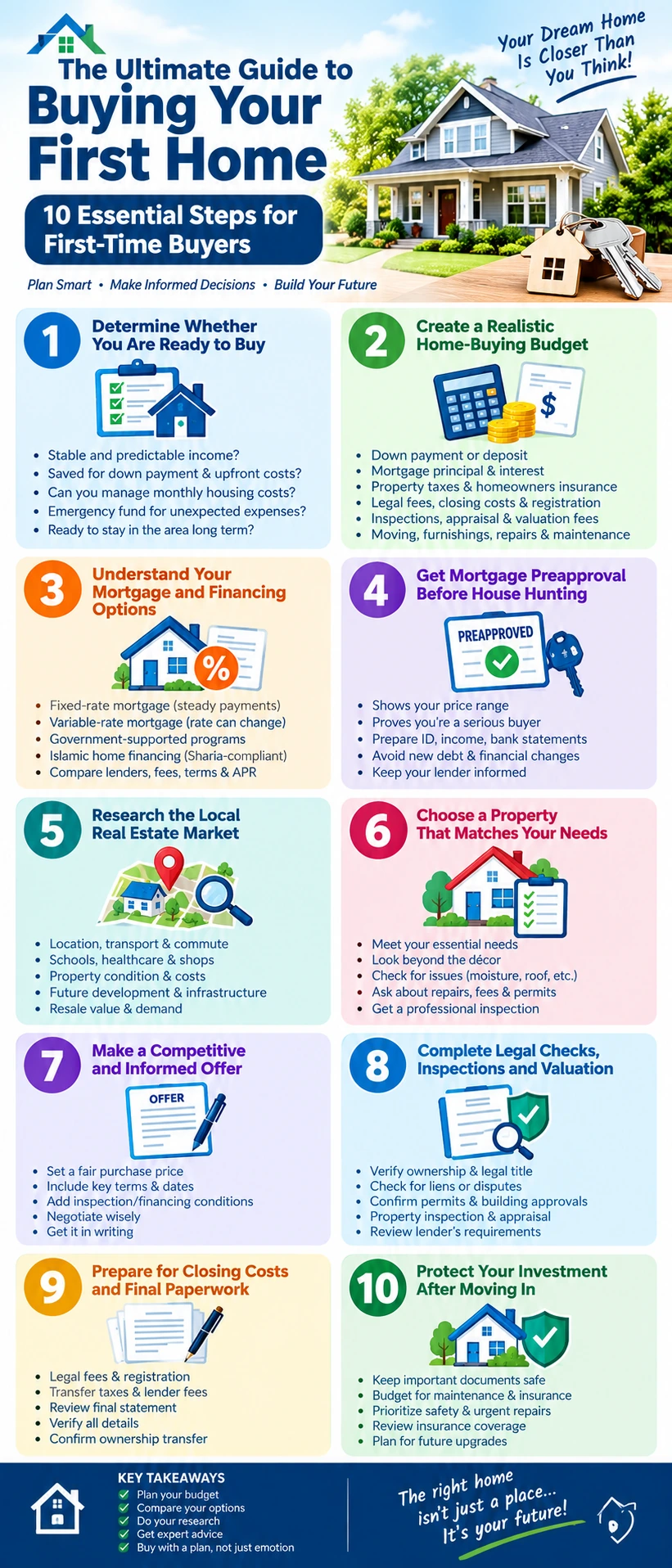
1. Determine Whether You Are Ready to Buy a Home
Before browsing property listings, evaluate your financial situation and long-term plans. Homeownership can provide stability, but it also brings responsibilities that renters may not face directly, including repairs, property taxes, insurance, and maintenance.
Ask yourself these questions:
- Do I have a stable and reasonably predictable income?
- Have I saved enough for the down payment and other upfront expenses?
- Can I manage monthly housing costs without sacrificing essential needs?
- Do I have emergency savings for unexpected repairs or income disruptions?
- Am I likely to stay in this location long enough to justify the transaction costs?
Your answers will help you decide whether to buy now or spend additional time preparing.
Example: Someone who has saved a deposit but has no emergency fund may be better off building additional savings before purchasing. A slightly later purchase can provide greater financial flexibility.
2. Create a Realistic Home-Buying Budget
Understanding how much house you can afford is one of the most important steps for first-time homebuyers. Your budget should account for more than the advertised property price.
Include these expenses:
- Down payment or deposit.
- Mortgage principal and interest.
- Property taxes and homeowners insurance, where applicable.
- Legal fees, registration charges, and closing costs.
- Home inspection, appraisal, and valuation fees.
- Moving expenses, utilities, and essential furnishings.
- Repairs, routine maintenance, and emergency savings.
Lenders assess affordability using factors such as income, existing debts, credit history, and their lending criteria. However, the amount a lender approves may exceed the amount you can comfortably afford.
Example: A first-time buyer’s budget
Suppose a property costs $250,000 and the buyer plans a 10% down payment. The figures below are illustrative, not estimates of actual fees in a particular market.
| Expense | Example amount |
|---|---|
| Property purchase price | $250,000 |
| Down payment (10%) | $25,000 |
| Illustrative transaction costs (3%) | $7,500 |
| Moving and initial setup | $2,000 |
| Total upfront cash needed | $34,500 |
The buyer would also need a separate allowance for emergencies and future maintenance. Actual transaction costs and minimum deposit requirements vary considerably by location and loan type.
A useful principle is to calculate your total monthly housing expense before deciding on a purchase price.
3. Understand Your Mortgage and Financing Options
A mortgage is a loan used to purchase property, usually secured against the home itself. Choosing the right financing arrangement can influence your monthly payment, total borrowing cost, and financial flexibility for years.
Common mortgage options include:
Fixed-rate mortgage: The interest rate remains fixed for the agreed period. This can make payments more predictable during that period.
Variable-rate mortgage: The interest rate can change according to the loan terms and relevant benchmark rates. Payments or borrowing costs may increase.
Government-supported homebuyer programs: Eligible buyers may qualify for assistance with deposits, interest costs, or other expenses. Eligibility, funding limits, and availability depend on the jurisdiction.
Islamic home financing: In markets offering Sharia-compliant financing, institutions may use structures such as diminishing partnership or other approved arrangements. Compare the contractual structure, total payment obligations, fees, and early-exit conditions.
Before applying, compare offers from multiple suitable lenders. Review the annual percentage rate or local equivalent, fees, repayment term, deposit requirements, and any penalties or restrictions.
4. Get Mortgage Preapproval Before House Hunting
Mortgage preapproval can help establish a realistic price range before you begin viewing properties. Lenders typically review financial information to estimate how much they may be willing to lend, subject to further checks and final approval.
Preapproval is not necessarily a guaranteed loan offer. Your circumstances, the property’s valuation, and the lender’s requirements may affect the final decision.
Prepare the documents commonly requested by lenders:
- Proof of identity and address.
- Recent payslips or other income evidence.
- Bank statements and savings records.
- Employment information or business financial statements.
- Details of outstanding loans and recurring obligations.
- Credit history information, where applicable.
Avoid taking on substantial new debt or making unexplained financial changes during the mortgage application process. Keep your lender informed if your employment or income changes.
5. Research the Local Real Estate Market
The right property is not simply the most attractive house you can afford. Location, transport links, neighborhood conditions, future expenses, and access to essential services all affect your day-to-day experience.
Research several neighborhoods and compare recent sales of similar properties. Asking prices alone do not establish market value, and advertised properties may sell for less or more depending on local demand.
Consider the following factors:
| Factor | What to investigate |
|---|---|
| Location | Commute, public transport, and road access |
| Essential services | Schools, healthcare, shops, and recreation |
| Property condition | Roof, plumbing, electrical systems, and structural concerns |
| Running costs | Taxes, insurance, utilities, and association fees |
| Future development | Planning proposals, construction, and infrastructure |
| Resale flexibility | Demand for similar homes and likely buyer appeal |
For example, a less expensive home farther from work might involve higher commuting costs and several additional hours of travel each week. Compare the overall lifestyle cost rather than the purchase price alone.
6. Choose a Property That Matches Your Needs
Prepare a list of essential requirements before arranging viewings. Separate non-negotiable features from preferences that you could compromise on.
Your essentials might include a safe and suitable location, adequate bedrooms, reasonable accessibility, and a manageable commute. Optional preferences might include a larger garden, a second bathroom, or a newly renovated kitchen.
During property viewings, inspect more than the decoration. Look for signs of moisture, cracks, poor ventilation, roof damage, drainage problems, and potentially outdated electrical or plumbing systems.
Ask about previous repairs, renovation permissions, service charges, utility costs, and any known disputes. Where appropriate, arrange an independent inspection by a qualified professional.
A professional inspection does not eliminate every risk, but it can reveal problems that are difficult to identify during a brief viewing.
7. Make a Competitive and Informed Offer
When you find a suitable property, determine a reasonable offer using comparable sales, the property’s condition, local demand, and your financial limits.
Your offer should reflect what the home is worth to you not simply how emotionally attached you have become to it.
Before submitting an offer, clarify:
- The proposed purchase price.
- What fixtures and appliances are included.
- The proposed completion or closing date.
- The deposit arrangements.
- Any financing, inspection, or valuation conditions available under local law.
- What happens if either party cannot meet the agreed terms.
Negotiation is not always about securing the lowest possible price. Flexible timing, clear documentation, and realistic conditions can also contribute to a successful transaction.
Never assume that a verbal promise replaces a properly documented agreement. Have a qualified local property professional review the contract where appropriate.
8. Complete Legal Checks, Inspections, and Valuation
Due diligence is one of the most important safeguards in the home-buying process. Before committing funds, establish that the seller has the legal authority to sell and that the property can be transferred as represented.
Depending on the jurisdiction, checks may involve:
- Confirming ownership and the property’s legal description.
- Reviewing title records, liens, mortgages, or other encumbrances.
- Verifying planning permission and building approvals.
- Checking property boundaries and access rights.
- Confirming applicable taxes, service charges, and outstanding dues.
- Investigating restrictions, disputes, or proposed developments.
A property inspection evaluates physical condition, while a lender’s appraisal or valuation estimates value for a particular purpose. These are different assessments and should not be treated as interchangeable.
If serious defects or legal concerns arise, pause and obtain qualified advice before proceeding. Your contractual rights to renegotiate or withdraw depend on the agreement and local law.
9. Prepare for Closing Costs and Final Paperwork
Closing, settlement, or completion is the stage when the transaction’s final requirements are satisfied and ownership is transferred under the applicable legal process.
Depending on the country, costs can include legal representation, registration charges, transfer taxes, lender fees, valuation expenses, insurance, and prepaid property expenses.
Request an itemized estimate rather than relying on a single headline figure. Compare it with the final statement before transferring funds.
Before signing, check that:
- The purchase price and financial figures are correct.
- The mortgage terms match the agreed offer.
- Required inspections and legal checks are complete.
- The transfer documents identify the correct property and parties.
- The payment instructions have been independently verified.
Be alert to payment fraud. If you receive new bank details by email or message, confirm them through a trusted, independently verified contact method before sending money.
Once the required documents are signed and funds have been transferred, confirm the legal registration or ownership-transfer requirements and arrange key collection.
10. Protect Your Investment After Moving In
Getting the keys is an important achievement, but responsible homeownership continues long after completion.
Start by organizing your purchase contract, ownership documents, mortgage records, insurance policies, inspection reports, and warranties. Keep digital copies in a secure location.
Create a monthly budget for utilities, maintenance, insurance, and any property-related charges. Set aside money for unexpected repairs instead of assuming that every spare dollar can be spent on furniture or upgrades.
Prioritize safety-related work and urgent repairs before cosmetic improvements. Keep records of major maintenance and improvements because they can help with future planning and, where relevant, a later sale.
Review your insurance coverage when your circumstances or the property’s condition changes. If you have a mortgage, understand your payment schedule and contact your lender early if financial difficulties arise.
Common First-Time Homebuyer Mistakes to Avoid
Even well-prepared buyers can make costly mistakes. Watch out for these common problems:
- Spending the entire savings balance: Keep an emergency reserve after paying the deposit and transaction costs.
- Ignoring recurring expenses: Taxes, insurance, repairs, and service charges can substantially increase the cost of ownership.
- Skipping professional checks: A property’s appearance does not establish its structural condition or legal status.
- Borrowing the maximum available amount: Choose payments that remain manageable under realistic household budgets.
- Rushing because of competition: Pressure from a seller or agent should not replace independent verification.
- Assuming assistance is guaranteed: Confirm current eligibility, application deadlines, and available funding with the official provider.
- Failing to compare lenders: Different rates, fees, and terms can produce materially different borrowing costs.
Author’s Thoughts: The Ultimate Guide to Buying Your First Home:
The best thing is to “Buy With a Plan, Not Just Emotion”. A first home should support your lifestyle and financial stability rather than become a source of constant pressure. It is easy to focus on attractive interiors, a desirable address, or the excitement of finally owning property. Yet the strongest decisions are usually based on affordability, careful research, and a willingness to walk away from an unsuitable deal.
My recommendation is to prioritize three things: a sustainable budget, independent due diligence, and a property that meets your genuine needs. A smaller home in a suitable location can be a better first purchase than a larger property that stretches your finances.
Do not measure success only by how quickly you buy. Measure it by whether you can comfortably maintain the home after the transaction is complete.
Conclusion : The Ultimate Guide to Buying Your First Home:
The Ultimate Guide to Buying Your First Home provides a practical roadmap for navigating the process from financial preparation to moving day. By assessing affordability, comparing mortgage options, researching neighborhoods, arranging inspections, verifying legal documents, and planning for ongoing costs, first-time buyers can make more informed decisions.
Before taking the next step, review your savings, obtain suitable financing advice, and confirm the legal requirements that apply in your market. Use a written checklist, ask questions whenever something is unclear, and resist pressure to commit before the essential checks are complete.
Homeownership is a major responsibility, but a careful, informed approach can make the experience more manageable and rewarding.
FAQs : The Ultimate Guide to Buying Your First Home:
1. How much money do I need to buy my first home?
The amount depends on the purchase price, required deposit, loan terms, transaction costs, and moving expenses. Calculate all upfront costs and preserve an emergency fund before committing.
2. What credit score do I need to buy a house?
There is no single universal minimum. Requirements vary by country, lender, and mortgage program. Credit history, income, existing debts, and the size of your deposit may also affect eligibility.
3. Should I get mortgage preapproval before looking at homes?
Generally, yes. Preapproval can help establish your budget and demonstrate that you have started the financing process. It does not guarantee final approval.
4. What are the hidden costs of buying a home?
Potentially overlooked expenses include legal fees, inspections, valuations, taxes, insurance, moving services, immediate repairs, utilities, and recurring property charges.
5. Is it better to buy a new or existing home?
A new home may offer modern systems and warranties, while an existing property may provide a more established location or different value opportunities. Compare condition, total costs, location, and applicable warranties before deciding.
6. How long does buying a home take?
The timeline varies with financing, property availability, legal checks, inspections, and local procedures. Ask your lender and legal representative for a realistic estimate based on your transaction.
7. Can first-time homebuyers receive government assistance?
Some jurisdictions offer eligible buyers grants, tax benefits, subsidized financing, or deposit assistance. Check official government and lender sources because eligibility and funding rules can change.
8. What should I check before making an offer?
Review comparable sales, the property’s condition, ownership documentation, likely ongoing costs, and any applicable restrictions. Understand the contractual protections available to you before committing.
9. Should I buy a home if I have limited savings?
Not necessarily. If the purchase would leave you unable to cover essential expenses or unexpected repairs, consider building a stronger financial reserve before proceeding.
10. What is the most important advice for first-time homebuyers?
Know your financial limits, independently verify the property, understand the contract, and never let urgency replace due diligence.