Virtual reality in real estate is transforming how buyers explore, evaluate, and purchase properties. By using immersive 3D walkthroughs, 360-degree videos, and VR headsets, real estate agents can offer convenient property tours without requiring physical visits. This technology saves time, expands marketing reach, and helps international buyers explore properties remotely.
The future prospects of virtual reality in real estate include AI-powered virtual assistants, interactive floor plans, augmented reality staging, and realistic tours of properties under construction. Although VR cannot replace physical inspections, its integration with digital marketing will create more engaging, efficient, and accessible property-buying experiences worldwide.
In real estate, For agents and sellers, offering VR tours can widen the pool of interested buyers and reduce the number of unnecessary in-person showings, saving time for everyone involved.
Virtual Reality in Real Estate: The Future of Property Tours
Virtual reality in real estate is transforming property tours by allowing buyers to explore homes, apartments, and commercial spaces remotely before arranging an in-person visit. Instead of relying entirely on photographs or short videos, buyers can navigate immersive environments, understand room layouts, and visualize how a property might suit their needs.
This technology is especially valuable for overseas investors, busy professionals, property developers, and real estate agents who want to make property marketing more convenient and informative.
The opportunity is becoming clearer as consumer research demonstrates continued interest in immersive listings. Zillow’s 2026 buyer research found that 69% of surveyed buyers believed 3D tours helped them understand a property’s space better than static photographs. However, virtual tours complement rather than eliminate physical inspections.
What Is Virtual Reality in Real Estate?
Virtual reality (VR) in real estate uses digital technology to create an interactive representation of a property. Users can explore a space through a compatible headset, computer, tablet, or smartphone, depending on the platform.
Some experiences use photographs captured in 360 degrees, while more advanced solutions create navigable three-dimensional environments from spatial scans.
Example: A prospective buyer interested in a two-bedroom apartment can explore the living room, inspect the kitchen layout, move between rooms, and examine the relationship between different areas without immediately travelling to the property.
Virtual property tours can be particularly useful when the buyer lives in another city or country.
VR, 360-Degree Tours, and 3D Tours: What is the difference?
These terms are related but are not interchangeable.
| Technology | How it works | Best use |
|---|---|---|
| 360-degree tour | Provides panoramic views from selected positions | Budget-conscious property marketing |
| Interactive 3D tour | Allows navigation through a digitally captured space | Understanding layouts and room connections |
| Headset-based VR | Places users inside an immersive digital environment | More immersive property exploration |
| Augmented reality (AR) | Overlays digital objects onto a real-world view | Visualizing furniture and design changes |
| Architectural VR | Presents a proposed building in a simulated environment | Marketing properties before construction |
Matterport’s guidance on 3D tours and digital twins provides a useful explanation of how spatial capture differs from ordinary panoramic imagery.
Why Virtual Reality In Real Estate: the Future of Property Tours?
The future of property tours is likely to combine immersive technology with traditional real estate services. VR offers a practical solution to several challenges that affect buyers and sellers.
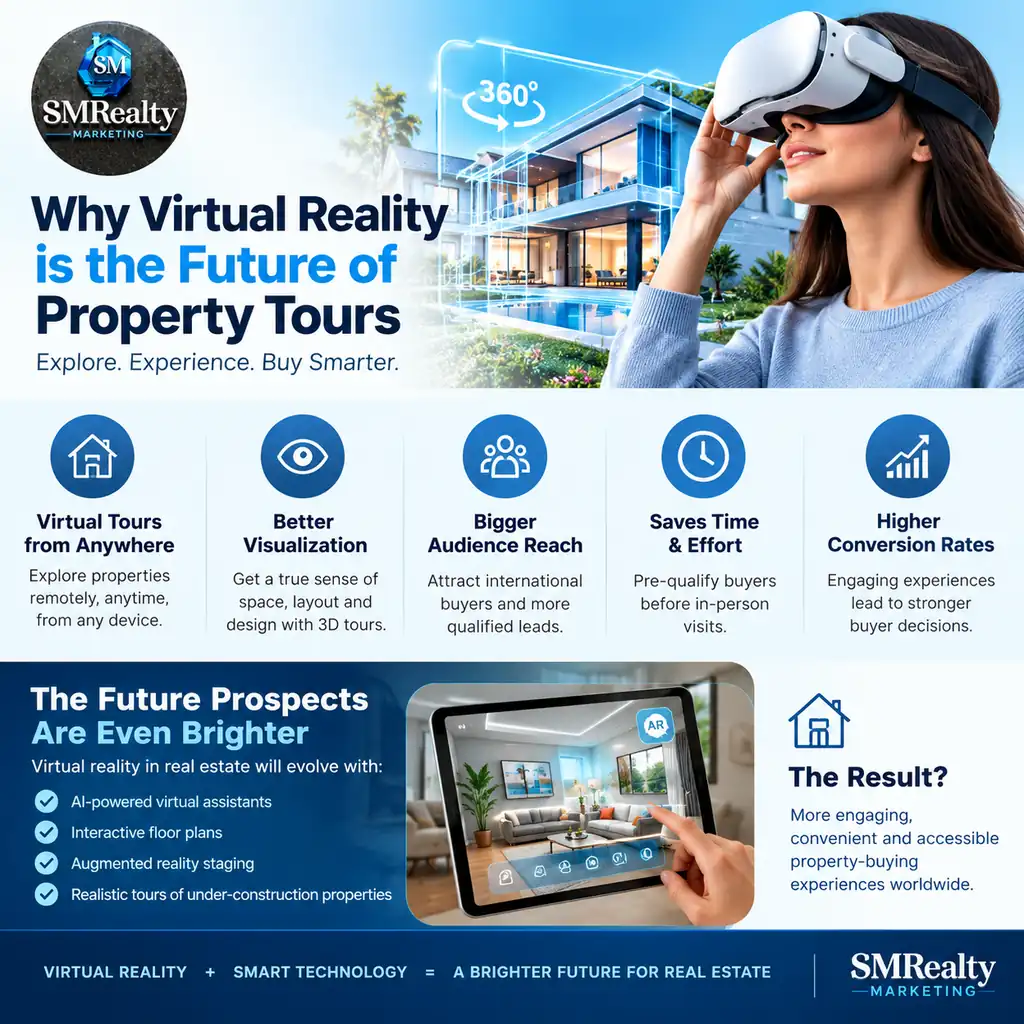
1. Property viewing from anywhere
Traditional property viewings require buyers and agents to coordinate schedules and travel to a physical location. This can be inconvenient for international investors, relocating families, and people comparing properties across different cities.
Virtual tours make it possible to explore available properties remotely.
Example: An investor living in London who is considering an apartment in Dubai can examine its layout online before booking a flight or arranging an inspection. The tour helps the investor shortlist suitable properties, although independent due diligence remains essential.
For agents, this expands the potential audience beyond people who can easily visit in person.
2. A better understanding of space
Photographs can make a room appear larger or smaller depending on the camera angle and lens. Floor plans provide measurements but may be difficult for inexperienced buyers to interpret.
An interactive 3D property tour helps users understand how rooms connect and how the available space is arranged.
Zillow’s 2026 research found that 69% of surveyed buyers agreed that 3D tours helped them understand a home’s space better than static photographs.
This supports the value of spatial visualization, although it does not prove that every VR listing generates more sales.
3. More efficient property marketing
Agents often spend considerable time showing properties to people whose requirements do not match the available space, location, or budget.
Virtual tours allow potential buyers to review properties before requesting an appointment. This can help agents focus their time on more relevant prospects.
For example, an agent marketing a residential development could provide an immersive tour of each available apartment type. Buyers could compare layouts online and arrange physical visits for the options that best match their preferences.
The practical benefit should be measured through qualified inquiries, completed viewings, and conversion rates rather than assumed.
4. Better marketing for properties under construction
Virtual reality is particularly useful when a building has not yet been completed.
Developers can create digital representations of planned apartments, office spaces, or residential communities. Buyers can explore proposed layouts and finishes before construction is finished.
A developer marketing an off-plan apartment could demonstrate different kitchen finishes, furniture arrangements, lighting options, and room configurations.
However, developers should clearly distinguish proposed visualizations from completed construction. Buyers must receive accurate specifications, disclosures, and contractual details.
5. Virtual staging and design visualization
Empty properties can make it difficult for some buyers to imagine how furniture and decorations would fit into a room.
Virtual staging adds digital furniture and decorative elements to property images or interactive environments. AR can also help users visualize selected furniture or finishes in their own surroundings.
These features can improve presentation and help buyers consider different design possibilities.
Agents should disclose digitally staged imagery and avoid presenting hypothetical renovations as existing features.
Benefits of VR Property Tours for Buyers, Sellers, and Agents
The benefits differ according to the user’s role.
| Audience | Main benefit | Practical application |
|---|---|---|
| Buyers | Convenient property exploration | Shortlist homes remotely |
| Sellers | Additional digital exposure | Present a property to more prospective buyers |
| Agents | More focused appointments | Qualify interest before physical viewings |
| Developers | Visualize unbuilt properties | Market off-plan apartments |
| Commercial landlords | Showcase complex spaces | Present offices, retail units, or warehouses |
| International investors | Reduce preliminary travel | Compare properties across markets |
These benefits are potential outcomes, not guaranteed results. Performance depends on image quality, listing accuracy, audience demand, and the effectiveness of the marketing strategy.
Real-World Examples of Virtual Reality in Real Estate The Future of Property Tours
Example 1: Residential property sales
A real estate agency photographs a furnished apartment and creates an interactive 3D tour. The listing includes the asking price, floor plan, room dimensions, location, and a contact form.
A buyer explores the apartment remotely, identifies the features that matter, and requests a physical viewing.
The agency can then compare the number of inquiries, qualified appointments, and offers generated by this listing with similar properties marketed using photographs alone.
Example 2: Off-plan property development
A developer preparing to launch a residential tower creates a digital walkthrough of a proposed apartment.
Prospective buyers can explore the living area, bedrooms, kitchen, and balcony before construction is complete. The developer provides a clear notice explaining which elements are proposed designs and which specifications are confirmed.
This approach can improve communication between developers and buyers.
Example 3: Commercial real estate
A company searching for office space may need to compare several buildings before committing to a lease.
Interactive tours allow decision-makers to review layouts, circulation areas, meeting rooms, and shared facilities without visiting every location immediately.
A physical inspection is still important for verifying building conditions, accessibility, infrastructure, and other operational requirements.
How to Implement Virtual Reality Property Tours?
Real estate businesses do not need to begin with an expensive custom VR application. A staged approach can help them determine whether immersive marketing is commercially worthwhile.
Step 1: Choose suitable properties. Start with high-value listings, off-plan developments, properties attracting remote buyers, or buildings with complex layouts.
Step 2: Select the technology. Compare 360-degree photography, interactive 3D scanning, and headset-based VR. Choose according to the property type, target audience, budget, and intended level of immersion.
Step 3: Capture the property accurately. Prepare the rooms, remove unnecessary clutter, use suitable lighting, and capture all important areas. Confirm that doors, room connections, and dimensions are represented honestly.
Step 4: Publish the tour. Embed the experience in the property listing and make it accessible on mobile devices and desktop computers. Include a floor plan, property specifications, photographs, and a clear call to action.
Step 5: Promote the listing. Share the tour through property portals, email campaigns, social media, and relevant landing pages. Target audiences that benefit most from remote viewing.
Step 6: Measure performance. Track tour engagement, inquiry rates, qualified leads, physical viewings, offers, and marketing costs.
Step 7: Improve based on results. Compare performance against similar listings and improve the tour, listing information, and follow-up process.
How Much Do Virtual Reality Property Tours Cost?
The cost varies according to the capture method, property size, production requirements, software subscription, and level of interactivity.
| Approach | Relative cost | Typical suitability |
|---|---|---|
| Smartphone-based 360-degree capture | Low | Individual agents and smaller properties |
| Professional 360-degree photography | Low to moderate | Standard residential listings |
| Professional 3D scanning | Moderate | Premium residential and commercial listings |
| Custom headset-based VR experience | High | Luxury developments and specialized marketing |
These are relative categories, not quoted market prices. Obtain current supplier quotations before budgeting.
A simple way to assess return on investment is:
ROI = (Incremental profit attributable to the tour − total tour cost) ÷ total tour cost × 100
For example, suppose a campaign costs $500 and generates an estimated additional $800 in attributable profit. Its estimated ROI would be 60%.
This is an illustrative calculation, not an industry benchmark. Businesses should use actual costs and credible attribution rather than counting every inquiry as a sale.
Limitations and Challenges of VR in Real Estate
Despite its advantages, virtual reality has important limitations.
- Technology costs: Professional capture and custom experiences may require substantial investment.
- Internet access: Large interactive environments may load poorly on slow connections.
- Accuracy: Poorly captured spaces can misrepresent dimensions, finishes, or room connections.
- Accessibility: Headsets may be uncomfortable or unsuitable for some users.
- Privacy: Property scans can reveal personal belongings, security features, and sensitive information.
- Trust: A virtual tour cannot reliably establish structural integrity, hidden defects, noise levels, or every aspect of a property’s condition.
The solution is to provide accurate tours, disclose staging, protect personal data, and encourage independent inspections and legal due diligence.
The Future of Virtual Reality in Real Estate
The next phase of immersive property marketing is likely to combine VR with artificial intelligence, digital twins, AR, and conversational interfaces.
AI-powered assistants could answer questions while users explore a property. For example, a buyer might ask whether a room can accommodate a particular furniture arrangement or request details about the building’s facilities. The assistant should distinguish verified listing information from estimates.
Digital twins could also connect visual property representations with maintenance records, building information, or other verified data where appropriate permissions and integrations exist.
For developers, real-time rendering may make it easier to compare proposed materials and layouts. For international buyers, multilingual interfaces could make remote exploration more accessible.
These developments represent plausible applications rather than guaranteed timelines. Adoption will depend on affordability, interoperability, data quality, and user demand.
Author’s Thoughts: Virtual Reality in Real Estate: The Future of Property Tours
Is VR Really the Future of Property Tours? Yes it is .
In my view, virtual reality is best understood as an evolution of the property-buying process rather than a complete replacement for traditional viewings.
The strongest value is not simply that a property can be viewed in 3D. It is that buyers can make better-informed decisions before spending time and money on a physical visit.
Real estate businesses should avoid adopting VR solely because it appears innovative. Instead, they should identify a specific customer problem, select the appropriate technology, measure results, and improve the experience using feedback.
A well-produced 3D tour with accurate measurements and transparent disclosures may be more useful than an expensive headset experience that fails to answer buyers’ questions.
Conclusion:Virtual Reality in Real Estate: The Future of Property Tours
Virtual reality in real estate is changing how properties are presented, explored, and shortlisted. Immersive tours can improve spatial understanding, support remote buyers, help developers market proposed buildings, and make property marketing more flexible.
Nevertheless, successful adoption requires accurate representation, reasonable costs, accessible design, and clear performance measurement.
For agents and developers, the most practical approach is to begin with suitable properties, integrate virtual tours into existing listings, and measure their impact on qualified inquiries and conversion rates.
The future of property tours will likely combine immersive digital experiences with professional advice, physical inspections, and reliable property information. Businesses that use these technologies to solve real customer problems will be better positioned to benefit from their continued development.
FAQs : Virtual Reality in Real Estate: The Future of Property Tours
1. Is virtual reality the future of property tours?
Yes, virtual reality is likely to play an increasingly important role in property tours because it allows buyers to explore spaces remotely and understand layouts before arranging physical visits. However, its adoption will vary by market, budget, and buyer preferences.
2. How does virtual reality work in real estate?
VR uses digital environments, panoramic images, or three-dimensional property scans to create an interactive viewing experience. Buyers can navigate rooms using a computer, smartphone, or compatible headset, depending on the technology.
3. What are the main benefits of virtual property tours?
The main benefits include remote access, better spatial understanding, convenient property comparisons, broader marketing reach, and potentially fewer unsuitable physical appointments.
4. Are 3D virtual tours better than traditional property photographs?
They serve different purposes. Photographs are quick to view and useful for showcasing details, while interactive 3D tours help buyers understand layouts and how rooms connect. Combining both usually provides more complete listing information.
5. Can virtual reality help sell off-plan properties?
Yes. Developers can create immersive visualizations of proposed buildings and apartments before construction is complete. They should clearly disclose that the experience represents a proposed design rather than a finished property.
6. How much does a real estate virtual tour cost?
Costs depend on property size, capture equipment, professional services, software, and customization. Agents should obtain supplier quotations and compare the total cost against measurable marketing outcomes.
7. Can buyers purchase a property without visiting it physically?
Some buyers purchase properties after remote viewings, particularly when relocating internationally. However, a virtual tour cannot establish every aspect of a property’s condition. Independent inspections, document verification, and legal due diligence are strongly recommended.
8. What is the difference between virtual reality and augmented reality in real estate?
VR creates an immersive digital environment in which users explore a property. AR overlays digital elements onto a view of the real world, such as visualizing furniture in an existing room.
9. Will AI replace real estate agents because of virtual tours?
Virtual tours and AI can automate parts of property discovery and customer communication, but agents continue to provide negotiation, local market knowledge, professional advice, and transaction support. Technology is more likely to change their workflows than eliminate every aspect of their role.
10. How can real estate agents measure the success of virtual tours?
Agents should measure tour engagement, qualified inquiries, scheduled viewings, offers, conversions, production costs, and attributable profit. Comparing similar listings with and without tours can help estimate their incremental value.