The best solution for flipping houses successfully is to research local real estate markets, purchase undervalued properties, and calculate the after-repair value (ARV) before investing. Follow these Tips for Flipping Houses Successfully by conducting professional property inspections, preparing a realistic renovation budget, and hiring reliable contractors.
Focus on cost-effective upgrades that attract buyers, such as kitchen improvements, bathroom renovations, fresh paint, and enhanced curb appeal. Always include financing, taxes, insurance, holding costs, and selling expenses when estimating profit. Maintain an emergency fund for unexpected repairs, monitor market trends, and establish a clear exit strategy to minimize risks and maximize potential returns.
Successful house flipping starts with finding the right property at the right price one where the purchase price plus renovation costs still leaves enough margin for a profitable sale. Many experienced flippers follow the 70% rule as a starting guideline: paying no more than 70% of a property’s after-repair value, minus renovation costs.
Accurately estimating renovation costs is critical, and it’s wise to build in a contingency budget of at least 10-15% for unexpected issues, which are common in older properties.
10 Tips for Flipping Houses Successfully in 2026
House flipping can generate attractive returns, but success depends on buying the right property, estimating renovation costs accurately, and understanding local market demand. These tips for flipping houses successfully will help beginners and experienced real estate investors evaluate deals, manage renovation projects, reduce financial risks, and sell properties strategically.
In 2026, tighter profit margins make careful planning more important than ever. Investors should calculate after-repair value (ARV), compare recently sold properties, budget for unexpected expenses, and include financing and selling costs before making an offer.
A disciplined investment strategy can help you avoid costly mistakes and make better property-flipping decisions.
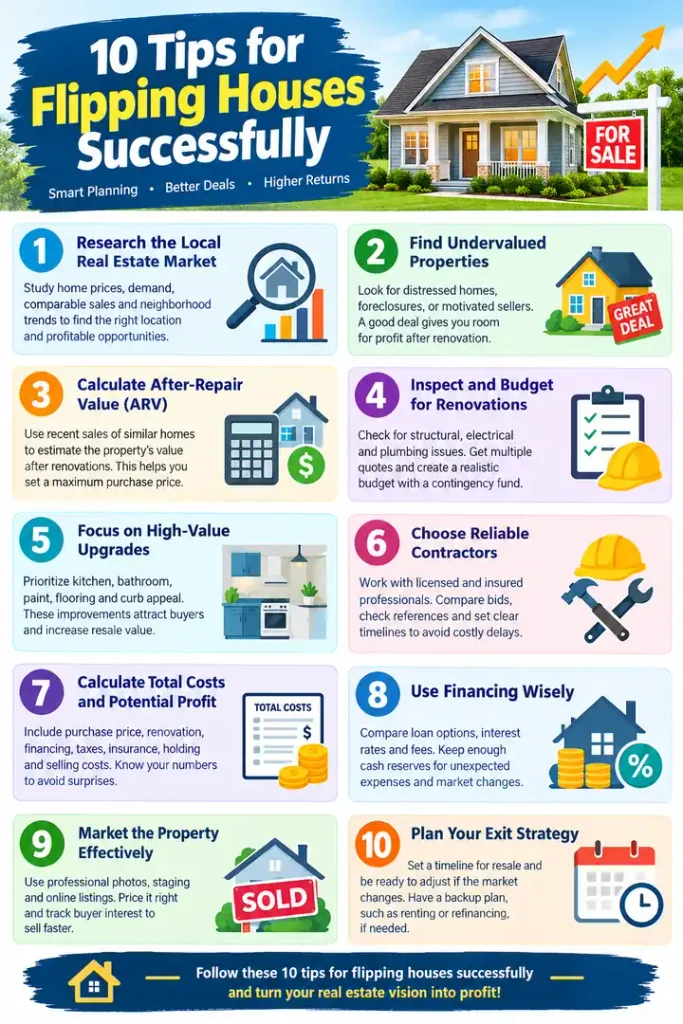
Why Is House Flipping Different in 2026?
Modern house flipping requires more than purchasing an inexpensive property and making cosmetic improvements. Investors must consider mortgage rates, renovation expenses, local inventory, buyer affordability, insurance, property taxes, and the time required to complete and sell a project.
According to ATTOM’s 2025 Year-End U.S. Home Flipping Report, the typical flipped home generated a gross return on investment of 25.5% in 2025, down from 32.1% in 2024. ATTOM’s Q2 2026 report subsequently reported a typical gross return of 21.5%, with $60,526 in gross profit.
These figures are national U.S. statistics, not guarantees for individual investments. They also exclude renovation expenses, financing, and other costs that reduce actual profit.
The lesson is simple: investors must evaluate each property individually rather than assume rising home prices will deliver a profitable flip.
1. Research the Local Real Estate Market
The first step is to identify a market where renovated properties attract sufficient buyer demand. A cheap property is not automatically a good investment if it is located in an area with declining demand or few comparable sales.
Research the following factors before purchasing:
- Recent home sale prices and price trends.
- Average days on market for comparable properties.
- Available inventory and competing renovated homes.
- Neighborhood amenities, transport, schools, and employment.
- Property taxes, insurance costs, and local regulations.
- The types of homes local buyers prefer.
Use recent closed sales rather than relying exclusively on asking prices. Compare properties with similar sizes, layouts, conditions, and locations.
Example: Suppose two neighborhoods offer properties at similar purchase prices. One has renovated homes selling quickly, while the other has several competing listings that remain unsold for months. The first neighborhood may offer a more predictable exit, provided its acquisition and renovation costs support an adequate return.
Pro tip: Build a specific investment profile, or buy box, defining your preferred location, property type, price range, renovation level, and target resale value.
2. Find Undervalued Properties With Real Profit Potential
Finding properties below their potential market value is one of the most important house-flipping skills. Common opportunities include outdated homes, inherited properties, distressed houses, and properties requiring manageable repairs.
Potential sourcing channels include:
- Multiple Listing Service (MLS) listings.
- Real estate agents and investor networks.
- Direct-to-owner marketing.
- Estate sales and inherited properties.
- Property auctions, after careful legal and financial checks.
- Local wholesalers with verifiable ownership and documentation.
Do not confuse a low asking price with a genuine bargain. A property may be inexpensive because of structural damage, title problems, unpaid taxes, zoning restrictions, or weak resale demand.
Before making an offer, establish why the property is undervalued and what specific improvements could increase its marketability.
3. Calculate After-Repair Value (ARV) Accurately
After-repair value is the estimated market value of a property after planned renovations are completed.
To estimate ARV, study recently sold comparable homes that resemble the finished property. Consider their location, size, age, bedrooms, bathrooms, condition, and sale dates.
Example: Imagine three comparable renovated homes sold for $285,000, $295,000, and $300,000. A preliminary ARV estimate might be $295,000, subject to differences in property features and market conditions.
Do not automatically use the highest comparable sale. Your renovated property may not justify the same price.
A reliable ARV estimate helps you establish your maximum purchase price, renovation scope, and expected resale proceeds.
4. Use the 70% Rule as an Initial Screening Tool
The 70% rule is a common real estate investing guideline for screening potential fix-and-flip deals.
Formula:
Maximum allowable offer = (ARV × 70%) − Estimated renovation costs
Suppose a house has an estimated ARV of $300,000 and requires $35,000 in renovations.
| Calculation | Amount |
|---|---|
| Estimated ARV | $300,000 |
| 70% of ARV | $210,000 |
| Renovation budget | $35,000 |
| Maximum offer under the rule | $175,000 |
The resulting $175,000 figure is a preliminary screening limit, not a guarantee of profit.
The rule may be too generous in a slow market with high financing costs or extensive repairs. In other markets, it may be unnecessarily conservative. Always calculate the full project economics, including acquisition costs, financing, holding costs, selling expenses, contingency reserves, and your desired profit.
5. Inspect the Property and Prepare a Detailed Renovation Budget
A professional property inspection can reveal problems that are not visible during an ordinary viewing.
Pay particular attention to:
- Foundation cracks and structural movement.
- Roof damage and water leaks.
- Electrical wiring and plumbing.
- Heating, ventilation, and air conditioning systems.
- Mold, dampness, and drainage.
- Windows, insulation, and energy efficiency.
- Potential asbestos, lead, or other hazardous materials in older properties.
Obtain written contractor estimates and divide the renovation into individual tasks. Include labor, materials, permits, disposal, inspections, and finishing work.
Example: A $30,000 initial renovation estimate could become $36,000 if unforeseen work adds 20%. Maintaining a contingency reserve can reduce the risk of running out of funds.
The appropriate reserve depends on the property’s condition and uncertainty. Older or structurally complex houses generally require more caution than properties needing only cosmetic improvements.
6. Prioritize Renovations That Buyers Value
The best renovation is not necessarily the most expensive one. Focus on improvements that address buyer expectations, correct major defects, and support the estimated resale price.
Common priorities include:
- Structural safety and essential repairs.
- Roof, plumbing, electrical, and drainage problems.
- Kitchen and bathroom functionality.
- Fresh paint, flooring, lighting, and hardware.
- Curb appeal, landscaping, and entrance improvements.
- Energy efficiency where the cost is justified.
- Neutral finishes that appeal to a broad audience.
Avoid over-improving a property beyond neighborhood standards. A luxury kitchen may not generate a sufficient premium in a market where buyers prioritize affordability.
Example: If local buyers prefer clean, functional kitchens, replacing damaged cabinets, improving lighting, and updating hardware may be more cost-effective than moving walls or installing premium appliances.
Research comparable renovated homes before committing to major design decisions.
7. Choose Reliable Contractors and Manage the Timeline
Contractor delays can increase loan interest, insurance, utilities, taxes, and other carrying costs. Effective project management is therefore essential to house-flipping profitability.
Before hiring a contractor:
- Verify references, qualifications, insurance, and relevant licenses.
- Obtain itemized written bids from multiple contractors.
- Confirm who is responsible for permits and inspections.
- Agree on milestones, payment terms, and completion dates.
- Document changes to the original scope of work.
- Inspect completed work before releasing milestone payments.
Use a project schedule that identifies dependencies. For instance, electrical and plumbing work generally must be completed before walls are closed and final finishes are installed.
Track spending weekly and compare actual expenses with the approved budget. Address delays early rather than allowing small problems to affect the entire project.
8. Calculate Total Costs and Realistic Net Profit
One of the biggest mistakes beginners make is confusing the difference between the purchase price and resale price with actual profit.
Your total project costs may include:
- Purchase price and acquisition closing costs.
- Renovation labor and materials.
- Inspection and permit fees.
- Loan interest and financing charges.
- Property taxes, utilities, and insurance.
- Maintenance and security.
- Agent commissions and resale closing costs.
- Staging, marketing, and contingency expenses.
Consider this illustrative example:
| Item | Amount |
|---|---|
| Purchase price | $180,000 |
| Renovation costs | $35,000 |
| Acquisition closing costs | $4,000 |
| Financing and holding costs | $12,000 |
| Selling costs | $18,000 |
| Total project costs | $249,000 |
| Resale price | $285,000 |
| Estimated net profit before tax | $36,000 |
The gross price difference is $105,000, but the estimated net profit is only $36,000 after the listed costs.
The estimated profit margin is 12.6% of the resale price, while the return on total project costs is approximately 14.5%. These are different measures and should not be confused.
Actual results depend on local fees, tax treatment, financing, and the final sale price. Consult qualified local professionals regarding tax obligations.
9. Use Financing Carefully and Keep Cash Reserves
House flippers may use cash, conventional financing, or short-term investment loans. Each option has different eligibility requirements, interest rates, fees, and repayment risks.
Before borrowing, compare:
- Interest rates and origination fees.
- Loan term and repayment schedule.
- Renovation funding and draw requirements.
- Early repayment penalties.
- Personal guarantees and collateral requirements.
- The consequences of selling later than expected.
Prepare a cash-flow forecast covering the purchase, renovation period, and resale. Keep sufficient funds available for overruns and delays.
Do not assume the property will sell immediately after renovations. Model a slower sale, a lower resale price, and higher costs to understand whether the investment remains viable.
Where appropriate, consider a fallback exit strategy, such as renting or refinancing. However, a rental strategy requires separate analysis of rental demand, financing terms, taxes, maintenance, and expected cash flow.
10. Market the Finished Property and Plan Your Exit
A successful renovation must be followed by an effective sales strategy.
Before listing the house:
- Complete a final inspection and repair outstanding defects.
- Gather permits, warranties, and renovation records.
- Arrange professional photography and accurate listing details.
- Stage the property where the expected benefit justifies the cost.
- Set an asking price based on recent comparable sales.
- Review buyer feedback and competing listings regularly.
Track listing views, inquiries, showing activity, and offers. If the property receives little interest, investigate whether the price, presentation, condition, or marketing strategy needs adjustment.
Set a maximum holding period before purchasing the property. If market conditions change, reassess the investment rather than holding indefinitely in the hope of achieving an unrealistic price.
Common House-Flipping Mistakes to Avoid
Even experienced investors can lose money when they overlook basic project risks.
| Mistake | How to reduce the risk |
|---|---|
| Overpaying for the property | Establish a maximum offer before negotiating |
| Overestimating ARV | Use recent, relevant closed sales |
| Underestimating renovation costs | Obtain detailed bids and maintain contingency funds |
| Ignoring holding costs | Include financing, taxes, insurance, and utilities |
| Making unnecessary upgrades | Match renovations to local buyer expectations |
| Hiring unverified contractors | Check references and document agreements |
| Underestimating the selling period | Model a delayed exit |
| Ignoring legal or title issues | Conduct due diligence with qualified professionals |
Author’s Thoughts On Tips for Flipping Houses Successfully
What Makes a House Flip Successful? In my view, the most important house-flipping skill is the ability to reject a bad deal before committing capital. Investors often spend too much time imagining how attractive a renovated house could become and too little time checking whether the numbers justify the purchase.
A disciplined investor starts with the resale market, works backward to establish a maximum offer, obtains realistic renovation estimates, and tests the financial outcome under less favorable conditions.
Technology can help compare listings, organize renovation budgets, track expenses, and monitor local market indicators. However, automated estimates should support—not replace—property inspections, professional valuations, and local expertise.
The goal is not to renovate every inexpensive property. It is to select projects where the potential reward justifies the financial and operational risks.
Conclusion On Tips for Flipping Houses Successfully
These tips for flipping houses successfully provide a practical framework for evaluating properties, managing renovations, controlling costs, and selling strategically. In the modern real estate market, profitability depends on realistic ARV estimates, disciplined purchasing, reliable contractors, adequate reserves, and an exit plan.
Before investing, calculate the complete project budget and test whether the deal remains viable if repairs increase, the resale price falls, or the sale takes longer than expected. If the numbers do not work under conservative assumptions, walking away may be the smartest investment decision.
Recommendations for First-Time House Flippers
Start with a manageable property that needs predictable repairs rather than a major structural reconstruction. Research comparable sales, inspect the house professionally, and obtain written contractor estimates before finalizing the purchase.
Maintain a detailed spreadsheet for every expense, establish a contingency reserve, and consult local legal, tax, and real estate professionals. Most importantly, do not rely on national averages or the 70% rule as substitutes for market-specific analysis.
A repeatable process and careful risk management are more valuable than chasing the highest projected return.
FAQs on Tips for Flipping Houses Successfully
1. What are the best tips for flipping houses successfully?
Research local demand, buy below realistic market value, calculate ARV, inspect the property, budget accurately, hire reliable contractors, control holding costs, and plan your resale strategy before purchasing.
2. Is house flipping profitable in 2026?
It can be profitable, but results vary significantly by location, purchase price, renovation requirements, financing, and resale demand. Recent U.S. data shows that gross returns have narrowed, making detailed financial analysis particularly important.
3. What is the 70% rule in house flipping?
The 70% rule suggests paying no more than 70% of a property’s estimated after-repair value minus renovation costs. It is a screening guideline rather than a universal investment formula.
4. How much money do you need to flip a house?
The amount depends on property prices, renovation requirements, financing, and available reserves. Calculate the down payment or cash purchase price, closing costs, renovation budget, holding costs, and contingency funds before proceeding.
5. How long does it take to flip a house?
The timeline varies according to the property’s condition, permits, contractor availability, renovation complexity, and resale demand. Include the purchase, renovation, marketing, and closing periods in your project forecast.
6. Which renovations provide the best value when flipping a house?
Essential repairs, fresh paint, flooring, improved lighting, functional kitchens and bathrooms, and curb appeal can improve marketability. The best choices depend on buyer preferences and comparable renovated homes in the local area.
7. How do you calculate house-flipping profit?
Subtract all project costs—including acquisition, renovation, financing, holding, and selling expenses—from the final sale price. The result is estimated profit before any applicable taxes not already included in the calculation.
8. What is the biggest risk in house flipping?
Overpaying for a property or underestimating its renovation and holding costs can eliminate the expected profit. Falling resale prices, title problems, contractor delays, and weak demand can also create substantial losses.
9. Should beginners flip houses with cash or financing?
Neither option is automatically best. Cash can reduce borrowing expenses, while financing may preserve liquidity but introduces interest and repayment obligations. Compare the full costs and risks of both approaches.
10. What should you do if a flipped house does not sell?
Review the asking price, competing listings, property presentation, and buyer feedback. Consider a price adjustment or evaluate a rental or refinancing strategy if financially and legally appropriate. Do not assume that holding the property longer will necessarily increase its value.