The age-old real estate adage “location, location, location” remains fundamental because while you can modify a building’s condition, you cannot change its physical surroundings. Evaluating a neighborhood requires analyzing both macro trends and micro indicators.
How to Assess Neighborhood Quality?
Knowing how to assess neighborhood quality is essential for homebuyers, property investors, sellers, and real estate professionals. A property’s value depends not only on its size, design, and condition but also on its surroundings, accessibility, safety, local services, and future development potential.
A well-located property may attract more buyers and tenants because it offers convenient access to employment, schools, healthcare, public transportation, and recreational facilities. However, an attractive neighborhood does not automatically guarantee higher returns. Buyers must also examine affordability, market trends, environmental risks, and legal restrictions.
This guide explains ten important factors for evaluating neighborhood quality, measuring property value, identifying investment opportunities, and making informed real estate decisions.
What Is Neighborhood Quality in Real Estate?
Neighborhood quality refers to the overall suitability, convenience, safety, infrastructure, environmental conditions, and economic stability of an area. It influences residents’ daily experiences and can affect housing demand, rental income, and resale opportunities.
For property investors, assessing neighborhood quality means evaluating both current living conditions and the factors that may influence future property performance.
For example, a residential area with reliable utilities, convenient transport, nearby healthcare, and well-maintained public spaces may appeal to a broader range of buyers than a similar area with poor road access and unreliable services.
10 Factors to Assess Neighborhood Quality and Property Value
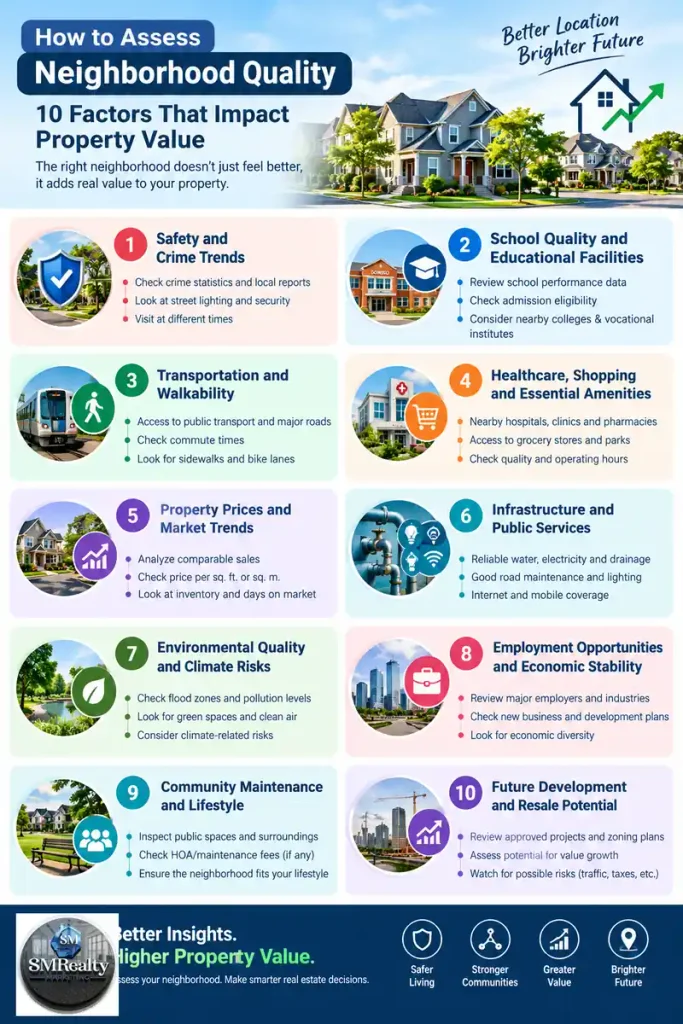
10 Factors to Assess Neighborhood Quality and Property Value
1. Safety and Crime Trends
Safety is an important consideration when choosing a neighborhood. Buyers should review official crime statistics, local police reports, street lighting, road conditions, and security arrangements.
Compare trends over several years rather than relying on a single incident or anecdotal opinion. Speak with residents and visit the area at different times of day.
For investors, perceptions of safety can influence tenant demand and the time required to sell a property. However, crime statistics should be interpreted carefully because reporting practices and neighborhood boundaries can vary.
2. School Quality and Educational Facilities
Access to schools, colleges, universities, and vocational institutions can influence a neighborhood’s appeal to households that prioritize education.
Evaluate school performance through official education records, inspection reports, and publicly available information. Check actual admission eligibility and school catchment boundaries rather than assuming that a nearby school is available to every property.
In markets where families prioritize education access, homes near suitable schools may attract stronger demand. The size of any price premium depends on local conditions and comparable sales.
3. Transportation and Walkability
Transportation access affects commuting costs, convenience, and the number of employment opportunities residents can reach.
Assess:
- Distance to major roads and public transportation.
- Average travel time during peak hours.
- Availability and condition of sidewalks.
- Safe pedestrian crossings and cycling routes.
- Access to employment centers and commercial districts.
The National Association of REALTORS® reported in July 2026 that 89% of surveyed Americans considered sidewalks and places to walk important when deciding where to live. Its findings also indicated that 63% would be willing to pay more for a walkable community.
These results demonstrate the relevance of walkability to buyer preferences, although stated willingness to pay does not guarantee a specific increase in market value.
4. Healthcare, Shopping, and Essential Amenities
Examine access to grocery stores, pharmacies, hospitals, clinics, parks, restaurants, and other services that residents use regularly.
A neighborhood that provides convenient access to essential services may be attractive to homeowners and tenants who want to reduce travel time.
For example, an apartment close to public transport, supermarkets, and healthcare facilities may appeal to professionals who do not want to depend entirely on a private vehicle.
Consider the quality, capacity, operating hours, and actual accessibility of these facilities rather than simply counting nearby businesses.
5. Property Prices and Local Market Trends
Analyze recent property transactions to understand whether prices are rising, falling, or remaining stable.
Compare similar properties based on location, property type, size, condition, age, and access to amenities. Examine price per square foot or square meter, median sale prices, inventory levels, and average time on the market where reliable data is available.
For example, if comparable homes in one neighborhood are selling faster than similar properties in another area, that may indicate stronger demand. However, differences in pricing, property condition, and available inventory must also be considered.
Use verified transaction data where possible instead of relying exclusively on advertised prices.
6. Infrastructure and Public Services
Reliable infrastructure supports daily living and can influence the attractiveness of a property.
Assess:
- Water supply and drainage.
- Electricity reliability.
- Waste collection.
- Internet and mobile coverage.
- Road maintenance and street lighting.
- Sewerage and flood-control systems.
In Pakistan, buyers should pay particular attention to water availability, electricity arrangements, sewerage, road access, and the approval status of a housing scheme.
A development advertised as having future infrastructure should be evaluated against approved plans, funding, construction progress, and responsible authorities’ records.
7. Environmental Quality and Climate Risks
Environmental conditions can affect residents’ health, maintenance expenses, insurance availability, and long-term property demand.
Investigate flood exposure, air pollution, industrial activity, noise, drainage, extreme heat, and access to green spaces. Review official hazard maps and environmental information wherever available.
For example, a property near a river or low-lying drainage channel may appear attractive but carry a greater risk of flooding. In hot climates, tree cover, building orientation, ventilation, and reliable utilities may also influence comfort and operating costs.
A thorough assessment should consider both current environmental conditions and potential future climate-related risks.
8. Employment Opportunities and Economic Stability
Neighborhoods near established employment centers, hospitals, universities, industrial zones, and commercial districts may benefit from a wider base of housing demand.
Research major employers, business openings and closures, commuting patterns, and publicly documented development plans.
Investors should avoid assuming that every announced project will be completed or increase nearby property prices. Confirm project approvals, financing, construction progress, and likely effects on traffic and local services.
Economic diversity can also matter: an area dependent on one major employer may be more exposed to job losses than a community supported by several industries.
9. Community Maintenance and Lifestyle
Observe the condition of public spaces, sidewalks, parks, street lighting, vacant plots, and common areas.
For apartment buildings and gated communities, review maintenance fees, management quality, reserve funds, and responsibility for shared facilities.
A well-maintained neighborhood may create a stronger first impression and support buyer confidence. Nevertheless, appearance alone is not reliable evidence of legal security, financial stability, or future appreciation.
Consider whether the neighborhood’s actual environment matches your needs, whether you are buying a family home, rental property, or commercial investment.
10. Future Development and Resale Potential
Assess whether planned transport improvements, commercial centers, schools, hospitals, or employment projects could change future housing demand.
Review official master plans, zoning documents, development approvals, public budgets, and construction updates.
Future development can create opportunities, but it may also introduce traffic congestion, noise, higher taxes or service charges, and pressure on existing infrastructure.
Estimate resale potential using comparable transactions, local supply, affordability, rental demand, and realistic holding costs. Treat forecasts as scenarios rather than guaranteed outcomes.
How To Access Neighborhood Quality Assessment: Comparison Table
| Factor | What to investigate | Possible property-value effect |
|---|---|---|
| Safety | Official crime trends and street lighting | May influence demand and buyer confidence |
| Schools | Performance and access eligibility | May increase appeal to education-focused households |
| Transport | Commute times and transit access | May expand the pool of potential buyers and tenants |
| Amenities | Shops, parks, and healthcare | May improve convenience and market appeal |
| Market trends | Comparable sales and inventory | Helps estimate market value and liquidity |
| Infrastructure | Utilities, drainage, and road quality | Can affect usability and maintenance costs |
| Environment | Flooding, pollution, and heat | May increase risk or operating expenses |
| Employment | Employers and economic diversity | May support housing demand |
| Maintenance | Public spaces and shared facilities | Can affect perceived quality and buyer confidence |
| Future development | Approved plans and project progress | May create opportunities or new risks |
These relationships are not universal. Property values depend on the interaction of local demand, supply, affordability, financing, property condition, and legal factors.
Examples of Neighborhood Analysis in Real Estate Markets
New York City, United States
In New York City, buyers may compare neighborhoods based on subway access, employment centers, parks, school access, and recent comparable sales. A property near convenient transit may attract buyers who value shorter commutes, but building condition, monthly charges, and local supply remain important.
Singapore
In Singapore, buyers may investigate access to MRT stations, employment districts, schools, amenities, and the applicable property ownership rules. Investors should also assess lease tenure, transaction costs, and restrictions that apply to the particular property.
Dubai, United Arab Emirates
In Dubai, neighborhood analysis may include access to employment hubs, metro services, schools, retail centers, building management, service charges, and the supply of competing apartments. A new development announcement should not be treated as proof of future capital appreciation.
Lahore and Islamabad, Pakistan
In Lahore and Islamabad, buyers can compare established urban neighborhoods with newer housing developments by examining approved layouts, road access, utilities, nearby services, and verified sale transactions.
Example: A plot in a developing housing scheme may have a lower purchase price but require a longer wait for infrastructure completion. An established neighborhood may offer greater immediate convenience but have less room for physical expansion or redevelopment.
In both cases, buyers should verify title documents, development approvals, outstanding dues, possession status, and applicable transfer requirements before committing funds.
How to Create a Neighborhood Quality Scorecard?
A simple weighted scorecard helps buyers compare locations consistently.
| Assessment category | Suggested weight |
|---|---|
| Safety | 20% |
| Transport and accessibility | 15% |
| Schools and essential amenities | 15% |
| Infrastructure | 15% |
| Property-market performance | 15% |
| Environmental conditions | 10% |
| Employment and future development | 10% |
| Total | 100% |
Rate each category from 1 to 5, where 1 means poor and 5 means excellent. Multiply each rating by its weight and divide the total by 5 to produce a score out of 100.
For example, a neighborhood receiving a weighted score of 82 would have performed well against the selected criteria. This is an illustrative assessment score, not a verified market valuation or prediction of investment returns.
Adjust the weights to match your needs. An investor focused on rental income may give more weight to tenant demand, vacancy rates, and transport access, while a household may prioritize safety, schools, and daily convenience.
Legal Due Diligence Before Buying Property
Neighborhood research should be accompanied by property-specific legal checks.
- Verify ownership and the chain of title through the appropriate land registry or competent authority.
- Check mortgages, liens, litigation, easements, and other recorded restrictions where applicable.
- Confirm zoning, permitted land use, building approvals, and development-scheme authorization.
- Investigate property taxes, service charges, utility arrears, and transfer fees.
- Review the sale agreement, payment terms, possession arrangements, and refund provisions.
- Confirm the legal status of proposed infrastructure and nearby development projects.
In Pakistan, the relevant procedure depends on the province, property category, land-record system, and responsible development authority. Obtain current records from the appropriate revenue office, land authority, or development authority, and consult a qualified local property lawyer before completing a high-value transaction.
Selling Strategies: How to Present Neighborhood Value
Sellers and real estate agents should demonstrate genuine location advantages instead of relying on broad marketing claims.
- Highlight verified distances to transport, hospitals, schools, parks, and commercial areas.
- Provide accurate property details and comparable-sale evidence where available.
- Explain completed infrastructure improvements separately from proposed projects.
- Share relevant utility, maintenance, and community-management information.
- Use clear photographs and maps that represent the actual location.
- Disclose material defects, known hazards, and legally required information.
- Avoid guaranteeing future appreciation or making unsupported claims about safety and school performance.
In the United States, real estate marketing must comply with applicable fair-housing and anti-discrimination laws. Agents should provide objective information rather than steering buyers toward or away from neighborhoods based on protected characteristics. Other jurisdictions have their own consumer-protection, advertising, and disclosure requirements.
Key Metrics “How to Assess Neighborhood Quality?”
- Economic Growth & Job Diversification: Look for areas with multi-sector job growth rather than reliance on a single employer or industry.
- School District Ratings: Strong public school systems drive consistent residential demand and support property resale values, even during market downturns.
- Transit & Connectivity: Proximity to major highways, public transit hubs, and commercial centers significantly improves desirable livability metrics.
- Commercial Investment Activity: Municipal infrastructure investments, incoming corporate offices, and new retail developments indicate high long-term growth potential.
- Local Crime Trends & Walkability: Review local police department crime maps over a 3-year period and assess community infrastructure such as parks, sidewalks, and local amenities.
Author’s Thoughts and Recommendations
In my view, neighborhood quality should be assessed as a combination of everyday convenience, measurable market evidence, legal security, and long-term resilience. A prestigious address is not automatically a good investment, and an affordable emerging area is not automatically undervalued.
Buyers should begin with their practical needs, investigate the available data, visit the area at different times, and compare actual transactions. Investors should also calculate rental yield, vacancy risk, maintenance expenses, transaction costs, and the possibility of slower resale.
The strongest purchase decision is one supported by verifiable evidence rather than promotional promises. No single score, nearby amenity, or proposed development can replace a complete property assessment.
Conclusion : How to Assess Neighborhood Quality?
Learning how to assess neighborhood quality helps buyers, sellers, and investors make better-informed real estate decisions. Safety, accessibility, schools, amenities, infrastructure, environmental risks, employment opportunities, and market trends all contribute to an area’s appeal.
However, neighborhood quality and property value are not identical. A desirable location can still contain overpriced properties, legal complications, or environmental risks. Combining reliable local data, physical inspections, comparable sales, and legal due diligence offers a more balanced approach.
Whether evaluating a home in New York, an apartment in Singapore, a development in Dubai, or a residential plot in Lahore or Islamabad, the objective is the same: identify a property whose location, price, risks, and long-term suitability align with your goals.
FAQS: How to Assess Neighborhood Quality?
1. How do you assess neighborhood quality before buying a house?
Review safety information, schools, transportation, amenities, infrastructure, environmental risks, recent comparable sales, and future development plans. Visit the neighborhood at different times and verify property documents before making an offer.
2. What factors affect neighborhood property values the most?
Location, local housing supply and demand, accessibility, employment opportunities, infrastructure, environmental risks, and property condition can all influence value. Their relative importance varies by market.
3. Does neighborhood quality increase property value?
It can. Strong access to amenities, reliable services, and desirable transportation options may support demand. However, the effect depends on local market conditions and whether the purchase price already reflects those advantages.
4. How can investors identify an emerging neighborhood?
Look for verified improvements in infrastructure, employment, amenities, housing demand, and transaction activity. Confirm planning approvals and construction progress, and compare potential returns with development, financing, and vacancy risks.
5. How can I measure neighborhood quality objectively?
Use a weighted scorecard based on documented criteria, such as safety trends, commute times, infrastructure, environmental exposure, comparable sales, and rental demand. State the data sources and limitations of the scoring method.
6. Why is walkability important in real estate?
Walkability can make daily activities easier by improving access to shops, parks, public transportation, and other destinations. Research suggests that many buyers value these features, but any property-price premium depends on the local market.
7. What should property buyers check in Pakistan?
Verify ownership records, the chain of title, development approvals, permitted land use, possession status, outstanding dues, utility availability, access roads, drainage, and any known litigation. Seek local legal advice when necessary.
8. Is a developing neighborhood better than an established neighborhood?
Not necessarily. Established areas may provide immediate amenities and proven demand, while developing areas may offer lower entry prices and potential growth alongside greater uncertainty. Compare total costs, risks, infrastructure delivery, and realistic resale scenarios before deciding.