Navigating The Rental Market as a Landlord: A Global Guide
The rental market can reward landlords with recurring income and long-term property growth, but success rarely comes from simply buying a property and collecting rent. Local demand changes, operating costs rise, tenants’ expectations evolve, and regulations differ between countries.
Imagine a landlord who owns two similar apartments. One remains occupied throughout the year, while the other experiences repeated vacancies and expensive repairs. The difference may not be the properties themselves. It may be how each landlord researches the market, sets rent, manages tenants, and plans for risk.
What Means By Navigating The Rental Market as a Landlord?
Navigating the rental market as a landlord means making informed decisions before problems become expensive. With a clear strategy, landlords can improve rental income, protect their properties, and build more resilient portfolios.
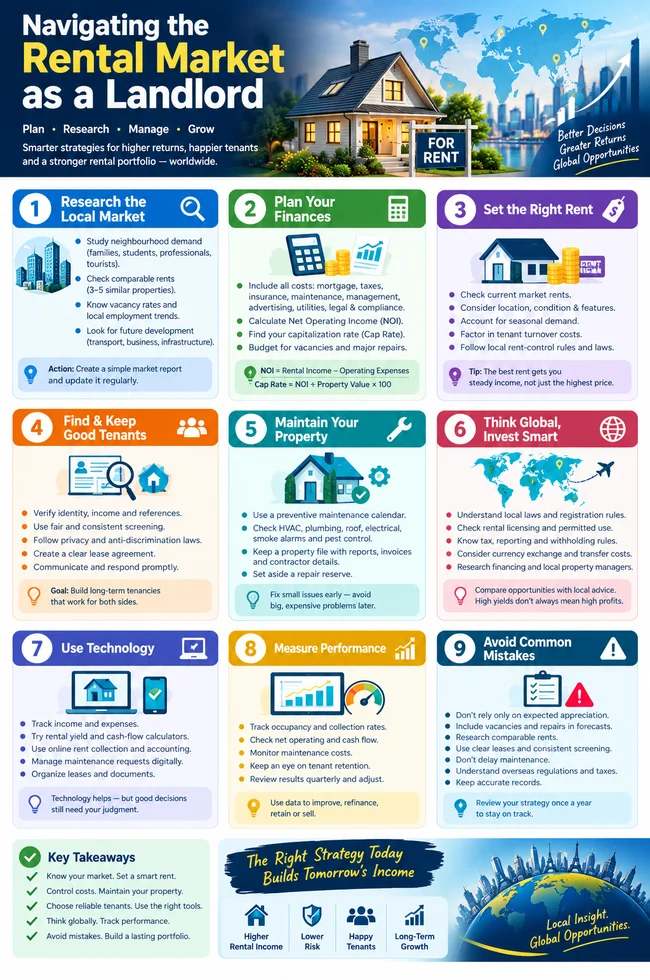
1. Understand Your Local Rental Market
As a Landlord before investing or adjusting rent, study the neighbourhood rather than relying on national property headlines. A country can experience rising rents while individual cities or districts face weaker demand.
Landlords Must Research these factors:
- Rental demand: Identify whether families, students, professionals, tourists, or relocating workers need housing.
- Comparable rents: Compare three to five similar properties, considering size, condition, furnishing, parking, and location.
- Vacancy rates: Investigate how long comparable properties typically remain available.
- Local employment: Major employers, universities, transport links, and infrastructure can influence tenant demand.
- Future development: New transport connections or business districts may attract renters, while excessive new construction can increase competition.
Example: A landlord near a university may find that smaller furnished units appeal to students, while a property near a business district may attract professionals seeking longer leases.
Action Plans: Create a simple market report for every property you own. Record competing rents, typical tenant profiles, vacancy periods, and major local developments. Update it regularly.
2. Build a Rental Property Financial Plan
A property with attractive monthly rent is not necessarily profitable. Landlords must account for expenses, financing, vacancies, and unexpected repairs.
Typical costs include:
- Mortgage interest and principal payments
- Property taxes and insurance
- Repairs and preventive maintenance
- Property management fees
- Advertising and tenant turnover
- Utilities paid by the landlord
- Legal, licensing, and compliance costs
Calculate the net operating income (NOI) before mortgage payments:
Net operating income = Rental income − Operating expenses
Then calculate the property’s capitalization rate:
Cap rate = Annual NOI ÷ Property value × 100
Example: A property generating $24,000 in annual rent with $8,000 in operating expenses has an NOI of $16,000. If its value is $250,000, its cap rate is 6.4%.
This figure helps compare properties, but it is not the same as cash-on-cash return or the investor’s final after-tax profit.
Budget for vacancies and major repairs instead of assuming every month will produce full rental income. A property that remains financially sustainable during difficult periods is often a stronger investment than one that looks impressive only under ideal conditions.
3. Set Competitive Rent Without Losing Good Tenants
Setting rent too high can increase vacancy periods. Setting it too low can leave money on the table and make maintenance harder to fund.
A practical rental pricing strategy should consider:
- Current asking rents for comparable properties.
- The condition, location, and features of your unit.
- Seasonal changes in demand.
- Tenant turnover costs and the time required to find a replacement.
- Applicable rent-control rules and legal restrictions.
Suppose a landlord can request $1,800 monthly but expects the property to remain empty for two months. An alternative rent of $1,700 with immediate occupancy could produce more income over the year.
Use actual local evidence rather than assuming that the highest advertised rent is the rent tenants will pay.
Review prices periodically, communicate changes clearly, and follow the notice requirements and tenant protections that apply in your jurisdiction.
4. Attract and Retain Reliable Tenants
Tenant quality and tenant experience directly affect a rental property’s stability. Frequent turnover can lead to advertising expenses, repairs, unpaid rent, and lost income.
Create a consistent tenant-screening process:
- Verify identity and relevant rental references lawfully.
- Assess income or ability to pay using appropriate documentation.
- Apply fair, consistent screening criteria.
- Follow local privacy, anti-discrimination, and housing laws.
- Explain the lease terms, deposit rules, maintenance responsibilities, and payment dates.
Once a tenant moves in, maintain clear communication. Respond promptly to repair requests, provide accurate payment records, and explain how emergencies will be handled.
A written lease should reflect local legal requirements and clearly describe rent, deposits, lease duration, permitted use, utilities, renewal, and termination procedures.
The goal is not merely to find a tenant; it is to create a tenancy that works for both parties.
5. Organize Maintenance Before It Becomes an Emergency
Deferred maintenance can turn a manageable repair into an expensive problem. It can also reduce tenant satisfaction and increase the likelihood of vacancies.
Build a preventive maintenance calendar covering:
- Heating, cooling, and ventilation systems
- Plumbing leaks and drainage
- Roofs, windows, and exterior structures
- Electrical safety and required inspections
- Smoke alarms and other locally required safety equipment
- Pest prevention and common areas
Keep a property file containing inspection reports, invoices, warranties, contractor details, and photographs of relevant work.
Set aside a reserve based on the property’s age, condition, climate, and likely repair costs. Older buildings may need larger reserves than recently constructed properties.
If you manage several properties, use a maintenance log or property management system to track requests, deadlines, expenses, and recurring problems.
6. Adapt Your Strategy to International Markets
Global landlords should avoid treating every rental market as if it followed the same rules.
A landlord in the United States may need to consider state and local landlord-tenant requirements. A UK landlord must monitor the applicable housing and tax rules. Investors in the European Union, Gulf countries, Asia, or elsewhere must research the relevant national and local requirements.
Before investing abroad, investigate:
- Foreign ownership and property registration rules
- Local rental licensing and permitted property use
- Income tax, withholding, and reporting obligations
- Currency exchange and cross-border transfer costs
- Mortgage availability and financing conditions
- Local property management and emergency support
- Tenant protections and legal procedures
Example: An overseas owner may receive attractive rental income in a foreign currency but lose part of the expected return through exchange-rate changes, management fees, and additional compliance costs.
Compare opportunities using consistent assumptions and local professional advice. A high advertised yield does not automatically mean a high-risk-adjusted return.
7. Use Technology to Improve Rental Management
Digital tools help landlords organize information and make better decisions without relying on memory or scattered spreadsheets.
Useful tools include:
- Rental income and expense trackers
- Rental yield and cash-flow calculators
- Online rent collection and accounting systems
- Maintenance request portals
- Digital lease and document management
- Local rental listing and market research platforms
Technology should support sound decisions rather than replace them. Verify market data, protect tenants’ personal information, and retain appropriate records.
For a small portfolio, a well-organized spreadsheet may be enough. Larger portfolios may benefit from dedicated property management software.
8. Measure Performance and Adjust Your Strategy
A rental portfolio needs regular reviews. Looking only at the rent received can conceal rising expenses or declining property performance.
Track these key indicators:
- Occupancy rate: The percentage of available rental time during which a property is occupied.
- Collection rate: The proportion of rent due that is actually collected.
- Net operating income: Rental revenue remaining after operating expenses.
- Net cash flow: Cash remaining after operating costs and financing payments.
- Maintenance cost per property: A measure of repair spending over time.
- Tenant retention: How consistently suitable tenants renew their leases.
Review results quarterly or at another practical interval. If vacancies rise, investigate pricing and tenant demand. If repairs increase, consider preventive maintenance or a larger capital improvement. If cash flow weakens, review expenses and financing rather than automatically increasing rent.
Use evidence to decide whether to improve, refinance, retain, or sell a property.
Common Landlord Mistakes to Avoid
Even experienced landlords can undermine returns by making avoidable mistakes.
- Buying based on expected appreciation without examining rental cash flow.
- Ignoring vacancy periods and major repairs in financial forecasts.
- Setting rent without researching comparable properties.
- Using unclear lease agreements or inconsistent screening practices.
- Delaying maintenance until tenants complain.
- Expanding internationally without understanding local regulations and taxes.
- Failing to keep accurate financial and property records.
A simple annual review can reveal these issues before they damage profitability.
Frequently Asked Questions Navigating The Rental Market as a Landlord
How can landlords identify a profitable rental market?
Compare local rents, tenant demand, vacancy periods, property prices, operating costs, and applicable regulations. Calculate expected net income and test how the investment performs under less favourable assumptions.
What is a good rental yield?
There is no universal target. Appropriate yields vary by location, financing costs, property condition, taxation, and risk. Compare similar properties in the same market rather than relying on a single global benchmark.
How often should landlords review rent?
Review comparable rents and property expenses periodically, such as every six to twelve months. Any rent adjustment must follow the lease and applicable local law.
Is professional property management worth the cost?
It can be valuable when landlords live far away, own several units, or lack time to handle maintenance and tenant communication. Compare management fees with the service provided and the time and risks saved.
Final Thoughts: Navigating The Rental Market as a Landlord
Navigating the rental market as a landlord requires more than collecting rent. It calls for local research, realistic financial planning, competitive pricing, responsible tenant management, preventive maintenance, and regular performance reviews.
Whether you own one apartment or a portfolio across several countries, start with reliable data and a written plan. Monitor what works, correct problems early, and adapt your decisions to local conditions.
The strongest rental strategy is not the one promising the highest income on paper. It is the one that balances sustainable returns, manageable risk, property quality, and a positive tenant experience over time.
Conclusion: Navigating The Rental Market as a Landlord
Being a successful landlord requires more than owning property. It means actively managing risk, cash flow, and tenant relationships. Start by researching comparable rentals in your area to price your unit competitively; overpricing leads to longer vacancies, while underpricing leaves money on the table.
Tenant screening is one of the most important steps in protecting your investment. Running credit and background checks, verifying income and employment, and contacting previous landlords can help you avoid costly turnover and missed payments down the line.
Staying current on local landlord-tenant laws is essential, as regulations around security deposits, eviction procedures, and habitability requirements vary widely and change often. Many landlords also find that investing in routine maintenance rather than waiting for issues to escalate saves money and keeps good tenants renewing their leases.