Successful home price negotiation starts with researching the local market, comparing recent property sales, and setting a realistic budget. To negotiate a lower house price, evaluate the property’s condition, identify necessary repairs, and understand the seller’s priorities.
Learning how to make an offer on a house can also help buyers secure favorable terms without exceeding their budget. Whether buying a first home or investing in real estate, effective negotiation helps buyers make informed decisions and achieve better value.
The best strategies for negotiating a better home price begin with market research, financial planning, and effective communication. Compare recent property sales to determine fair market value before making an offer.
Understanding how to negotiate a lower house price also requires evaluating property conditions, repair costs, and current market demand. Follow practical tips for negotiating home prices, such as setting a realistic budget, researching seller motivation, and preparing a strong offer.
Effective home price negotiation strategies include requesting reasonable repairs, negotiating closing costs, and responding professionally to counteroffers. These real estate negotiation tips for buyers can help secure better terms.
Getting pre-approved for financing strengthens your position, showing sellers you’re a serious and capable buyer. It’s also worth asking your agent about the seller’s motivation; someone relocating for a job or managing an estate sale may be more flexible on price or terms.
Strategies for Negotiating a Better Home Price: 10 Proven Tips for Buyers, Sellers, and Investors
Buying or selling a home is one of the most significant financial decisions a person can make. Even a small difference in the agreed price can affect mortgage payments, available savings, investment returns, and long-term financial security. However, successful property negotiation involves much more than asking for a discount or accepting the highest offer.
The best strategies for negotiating a better home price combine market research, financial planning, effective communication, and a clear understanding of a property’s actual value. Buyers want to avoid overpaying, sellers want to protect their equity, and property investors need to secure deals that support their financial objectives.
Whether you are purchasing your first home, selling an existing property, or expanding a real estate portfolio, the right approach can help you negotiate confidently without jeopardizing a worthwhile transaction.
In this guide, we explore 10 proven home price negotiation strategies, practical examples, and mistakes to avoid when negotiating with home sellers or buyers.
Why Is Home Price Negotiation Important?
The asking price is the amount a seller hopes to receive, but it does not automatically represent a property’s fair market value. The final price depends on several factors, including location, property condition, recent comparable sales, buyer demand, financing, and the seller’s circumstances.
For example, imagine a house listed for $400,000. A buyer discovers that similar homes have recently sold for approximately $380,000 and that the property requires $8,000 in essential repairs.
Instead of making an arbitrary low offer, the buyer can use the comparable sales and documented repair estimates to support a lower proposal.
The seller may accept, reject, or counter the offer. Even if the parties do not agree on the initial price, they may find a solution through repair credits, closing-cost assistance, or a different closing date.
The objective is not necessarily to achieve the lowest possible price. It is to reach a fair agreement that reflects the property’s condition, the market, and the financial interests of both parties.
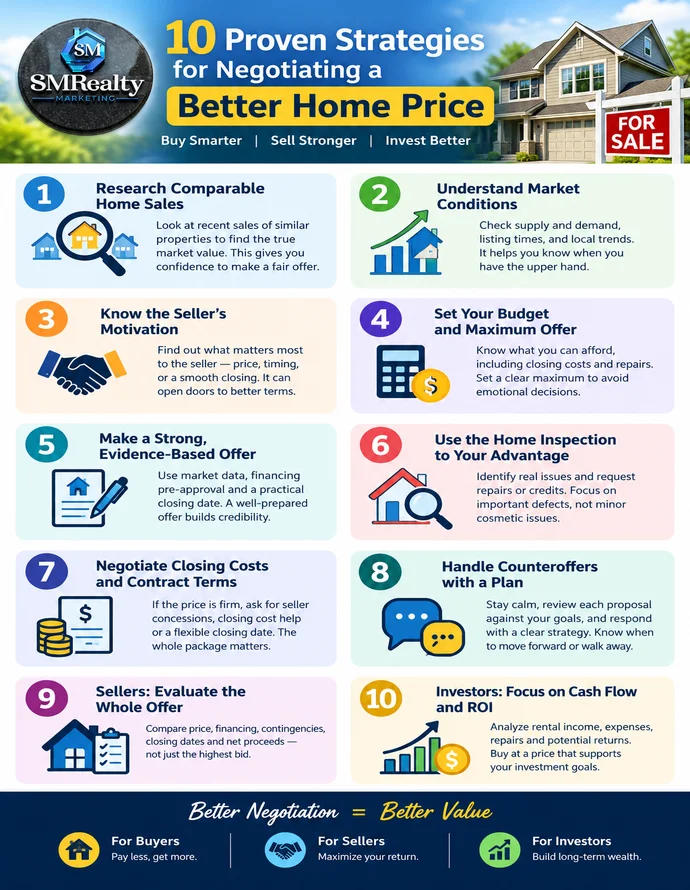
10 Proven Strategies for Negotiating a Better Home Price
1. Research Comparable Home Sales Before Making an Offer
One of the most effective home price negotiation strategies is to establish what similar properties have actually sold for.
Comparable sales, often called comps, help buyers and sellers estimate fair market value. Ideally, compare recently sold properties in the same neighborhood with similar characteristics, including:
- Property size and usable floor area
- Number of bedrooms and bathrooms
- Location, street, and neighborhood amenities
- Age, construction quality, and overall condition
- Lot size, parking, and outdoor space
- Recent upgrades or necessary repairs
Prioritize completed transactions over asking prices. A property advertised for $450,000 may eventually sell for considerably less, so its original listing price alone is not reliable evidence of market value.
Example: A seller lists a three-bedroom house for $420,000. Three reasonably comparable properties recently sold for $395,000, $400,000, and $405,000. After adjusting for differences in condition and features, a buyer may reasonably explore an offer near $395,000 to $400,000.
These figures are illustrative, not a valuation of an actual property.
A real estate agent can prepare a comparative market analysis, while local transaction records and reputable property databases may provide additional evidence.
Why it works: Evidence-based offers give both parties a rational starting point and reduce the influence of unrealistic expectations.
2. Understand Local Market Conditions and Timing
Your negotiating power changes according to the balance between housing supply and buyer demand.
In a buyer’s market, available homes outnumber active buyers. Sellers may face more competition and become more willing to negotiate.
In a seller’s market, desirable properties attract multiple offers, giving owners greater bargaining power. Buyers may need to submit stronger proposals and respond quickly.
Before deciding how to negotiate a lower house price, investigate:
- The number of comparable homes currently listed
- Recent price reductions in the neighborhood
- How long the property has been on the market
- Whether similar homes are selling above or below asking price
- The number of competing offers, if that information is available
- Seasonal patterns and local employment or economic conditions
A home that has remained unsold for several weeks may offer more negotiating opportunities than a newly listed property attracting substantial interest. However, listing duration is only a clue; it does not prove that a seller is desperate.
Example: A property has been listed for 75 days, and two similar homes nearby have recently reduced their prices. The buyer can use those changes to support a carefully researched offer rather than simply requesting a random discount.
Practical tip: Reassess the local market shortly before submitting your offer. Conditions can change, and older sales data may not reflect current demand.
3. Understand the Seller’s Motivation
Negotiating with home sellers becomes easier when you understand what matters most to them.
Some sellers prioritize a high sale price. Others need a quick closing because of relocation, a new home purchase, financial commitments, or an inherited property they no longer wish to maintain.
You should not assume that every seller is under pressure. Instead, ask respectful questions through the seller’s agent or your own representative.
Useful questions include:
- What closing date would work best for the seller?
- Are there particular contract terms the seller prefers?
- Has the property received other offers?
- Is the seller prioritizing price, timing, or transaction certainty?
- Are any appliances or furnishings included in the sale?
Suppose a seller needs to move within six weeks. A buyer with financing already arranged and a realistic closing schedule may be able to negotiate a better price or more favorable terms.
Another seller may prefer a slightly higher offer from a buyer who can accommodate a delayed possession date.
Why it works: Negotiations improve when both parties understand their priorities and identify terms that create value without necessarily increasing the purchase price.
4. Establish Your Budget and Maximum Offer Before Negotiating
Before deciding how much to offer on a house, calculate what you can comfortably afford.
Your budget should include more than the purchase price. Consider the down payment, mortgage payments, closing costs, property taxes, insurance, maintenance, utilities, and any homeowners’ association charges.
For financed purchases, obtain mortgage pre-approval where appropriate. Remember that pre-approval is not the same as final loan approval, and your lender may require additional checks.
Set three figures before negotiations begin:
- Your preferred purchase price.
- Your realistic target price based on the evidence.
- Your absolute maximum, including the effect of expected repairs and other costs.
For example, a buyer might have a maximum overall purchase budget of $410,000 but prefer to purchase a property for $390,000. If the house needs $12,000 in repairs and other acquisition expenses are expected to be $8,000, a $410,000 purchase price would exceed that budget once the additional expenses are included.
The buyer should therefore calculate the maximum purchase price by subtracting expected expenses from the total available budget.
Why it works: Establishing a financial limit prevents emotional bidding and helps buyers walk away from properties that no longer make financial sense.
5. Make a Strong, Evidence-Based Initial Offer
Learning how to make an offer on a house involves more than choosing a number below the asking price.
A credible offer should reflect comparable sales, the home’s condition, local demand, your financial position, and the seller’s circumstances.
Avoid assuming that a particular percentage below asking price will work everywhere. A reasonable opening offer in one market could be unrealistic in another.
When preparing your offer:
- Explain the basis for your proposed price.
- Provide evidence from comparable sales when appropriate.
- Include mortgage pre-approval or proof of funds where relevant.
- Propose a practical closing date.
- State which items or repairs are included in the offer.
- Set out applicable financing, inspection, and other conditions.
- Specify the response deadline and deposit arrangements according to local practice.
Example: A home is listed for $350,000, but recent comparable sales support a value around $335,000. The inspection also identifies repairs requiring professional estimates. A buyer might offer $330,000, explaining the comparable sales and the property’s condition.
The seller may reject the offer, counter at $342,000, or invite further discussion. The buyer can then evaluate whether the counteroffer remains within their financial limits.
A low offer without supporting evidence can undermine credibility. A well-supported offer shows that the buyer has done their homework.
6. Use the Home Inspection to Negotiate Repairs or Credits
A professional home inspection can reveal problems that were not obvious during a viewing. Depending on the property, these may include roof deterioration, plumbing leaks, electrical defects, drainage problems, or structural concerns.
When the inspection identifies significant issues, buyers may be able to request repairs, a price reduction, or a seller credit, subject to the purchase agreement and local law.
The strongest requests focus on documented, material problems rather than every minor cosmetic imperfection.
A practical process is to:
- Obtain the inspection report.
- Identify the most important defects.
- Request estimates from qualified contractors when appropriate.
- Separate urgent repairs from optional improvements.
- Submit a clear written request with supporting evidence.
- Review the seller’s response before deciding how to proceed.
Example: A home inspection identifies roof repairs estimated at $7,500. The buyer can request a corresponding price adjustment, ask the seller to complete agreed repairs, or negotiate an appropriate credit if permitted.
The seller may agree to the full amount, offer a partial credit, or decline. The buyer must then decide whether the remaining cost is acceptable.
Remember that an inspection does not automatically entitle the buyer to a discount. The available options depend on the contract, the nature of the defect, and local requirements.
Do not waive an inspection contingency or other important protection without understanding the financial and legal risks.
7. Negotiate Closing Costs and Contract Terms, Not Just Price
Sometimes a seller will not reduce the purchase price but may consider other concessions.
This is an important principle in real estate negotiation: the financial value of a deal depends on the entire agreement, not just the headline price.
Possible negotiation points include:
- Seller contributions toward eligible closing costs
- Repair credits or agreed repairs
- Included appliances or fixtures
- A flexible closing date
- A mutually acceptable possession date
- Allocation of certain transaction expenses
- Other contract terms permitted by local law and lending rules
Example: A buyer and seller agree on a $400,000 purchase price, but the buyer is concerned about closing expenses. Instead of requesting a $10,000 price reduction, the buyer asks for $6,000 toward eligible closing costs.
If the seller agrees and the lender and contract permit the concession, the buyer may need less cash at closing. However, the concession does not necessarily reduce the property’s price or the total interest paid over the mortgage term.
Buyers should compare the effects of price reductions, closing-cost assistance, and mortgage-rate options rather than assuming that all concessions have identical value.
Why it works: Flexible terms can help both parties achieve their priorities without reopening every aspect of the transaction.
8. Respond to Counteroffers With a Clear Negotiation Plan
Counteroffers are a normal part of many property transactions. A seller may reject the proposed price but offer different terms, while a buyer may respond with a revised price or another concession.
The key is to remain calm and evaluate each proposal against your original plan.
Before responding, ask:
- Does the counteroffer reflect the property’s supported market value?
- Can I afford the revised price and related expenses?
- Are the contract terms acceptable?
- What evidence supports my next proposal?
- Is there a reasonable alternative property?
- At what point should I walk away?
For example, a buyer offers $380,000 for a property listed at $400,000. The seller counters at $395,000. The buyer’s research suggests a fair value of $385,000 to $390,000.
The buyer might respond at $387,000 and explain the comparable sales supporting that figure. The seller could accept, counter again, or reject the offer.
There is no requirement to split the difference automatically. A midpoint is only useful if it makes financial sense.
Practical tip: Keep written records of offers, counteroffers, deadlines, and agreed changes. Ensure all final terms are documented in the appropriate contract.
9. Sellers Should Evaluate the Whole Offer, Not Just the Highest Price
Negotiation strategies are equally important for homeowners selling a property.
A high offer may look attractive, but it may involve uncertain financing, extensive contingencies, an impractical closing date, or other conditions that increase the risk of a failed transaction.
Compare offers based on their expected net proceeds and likelihood of completion.
Consider:
- The offered price
- Outstanding mortgage payoff and transaction costs
- Buyer financing and proof of funds
- Inspection and appraisal conditions
- Proposed closing and possession dates
- Requested seller concessions
- The financial consequences if the transaction fails
Example: Seller A receives two offers.
- Offer A: $420,000 with substantial financing uncertainty and a request for significant closing assistance.
- Offer B: $414,000 from a well-prepared buyer with stronger financing documentation and a closing schedule that suits the seller.
Offer B might be preferable if its terms produce better expected net proceeds and a more reliable closing. However, the seller should compare the actual contract conditions rather than assume that any buyer is guaranteed to close.
Sellers should also prepare the property’s documentation, disclose required information, and address known issues appropriately. Transparency can help prevent late-stage disputes.
Why it works: A successful sale depends on both the price and the quality of the agreement.
10. Property Investors Should Negotiate Based on Cash Flow and Return on Investment
Property investors need a different perspective from buyers purchasing a home primarily for personal use.
A property may look attractive because of its location or expected appreciation, but the numbers must support the investment.
Before making an offer, estimate:
- Expected rental income
- Vacancy and collection losses
- Property management expenses
- Insurance, taxes, and maintenance
- Immediate renovation costs
- Financing expenses
- Expected net operating income
- Potential resale value and transaction costs
For rental properties, net operating income (NOI) is generally calculated by subtracting operating expenses from effective rental income, before mortgage payments and income taxes.
A property’s capitalization rate, or cap rate, is its annual NOI divided by its purchase price, expressed as a percentage.
Example: An investment property generates $30,000 in annual effective rental income and has $10,000 in annual operating expenses.
Its annual NOI is $20,000.
At a purchase price of $300,000, its cap rate is approximately 6.67%. If the investor negotiates a purchase price of $280,000 while the estimated NOI remains unchanged, the cap rate rises to approximately 7.14%.
These are simplified illustrative figures. Actual returns depend on the property’s condition, vacancies, financing, taxes, transaction costs, and future expenses.
Investors should also account for renovation overruns and avoid relying entirely on projected appreciation.
The best deal is not always the cheapest property. It is a property purchased at a price and on terms that fit the investor’s risk tolerance and financial objectives.
Common Mistakes to Avoid When Negotiating a Home Price
Even well-informed buyers and sellers can weaken their negotiating position by making avoidable mistakes.
Making an offer without researching the market
An unsupported offer may be too high to protect your budget or too low to be taken seriously. Research recent comparable sales before proposing a price.
Letting emotions control the decision
Falling in love with a home can lead to overbidding. Sellers can also reject reasonable offers because they are emotionally attached to their property. Keep the discussion focused on evidence and financial goals.
Revealing your maximum budget too early
Buyers generally benefit from establishing a private maximum rather than immediately disclosing it. Share relevant financial information when required, but avoid volunteering your entire negotiating limit unnecessarily.
Ignoring inspection findings
Overlooking a major defect can create unexpected costs after closing. Obtain professional assessments and consider the potential consequences before committing.
Waiving protections without understanding the risks
Removing financing, appraisal, or inspection protections can make an offer more attractive in some circumstances, but it can also expose the buyer to substantial financial losses. Understand the contract and consult a qualified local professional before making that decision.
Focusing only on the purchase price
A lower price may not be the best deal if it comes with expensive repairs, unfavorable financing, or impractical terms. Evaluate the total cost of ownership.
Failing to document the agreement
Verbal promises about repairs, appliances, deposits, and closing expenses can create disputes. Put agreed terms in writing and follow the applicable legal requirements.
Practical Checklist Before You Negotiate
Use this checklist before making or responding to an offer.
- Research recent comparable sales.
- Review current listings and local market conditions.
- Determine your budget and maximum acceptable price.
- Understand the other party’s priorities where possible.
- Obtain relevant inspection reports and repair estimates.
- Review financing, deposits, and applicable contingencies.
- Compare price reductions with other possible concessions.
- Establish a clear counteroffer strategy.
- Document the final terms and deadlines.
- Verify ownership, title, and required legal documentation.
Property procedures differ by jurisdiction. In the United States, buyers and sellers commonly work with agents, lenders, inspectors, and closing professionals. In Pakistan and other markets, title verification, ownership records, transfer charges, and the role of local authorities may differ substantially. Obtain advice from a qualified professional familiar with the relevant location.
Frequently Asked Questions
How much below asking price should I offer on a house?
There is no universal discount that works for every property. Your offer should reflect recent comparable sales, the home’s condition, market demand, and the seller’s circumstances. In a competitive market, a near-asking or above-asking offer may be necessary; in a slower market, a lower evidence-based offer may be reasonable.
What is the best way to negotiate a lower house price?
Start by researching comparable sales, estimating repair costs, and understanding local market conditions. Submit a realistic written offer, explain the evidence supporting it, and remain open to reasonable counteroffers or other concessions.
Can I negotiate after a home inspection?
Potentially, yes. Depending on your contract and local law, you may be able to request repairs, a price reduction, or a seller credit. Your rights depend on the inspection provisions, deadlines, and applicable legal requirements.
Is it better to negotiate the price or closing costs?
It depends on your financial circumstances. A price reduction lowers the purchase price, while a permitted seller contribution toward closing costs may reduce the cash required at closing. Compare the actual financial effects, including lender limits and other contract terms.
Should sellers accept the highest offer?
Not automatically. Sellers should compare net proceeds, financing certainty, contingencies, deadlines, and the risk of a failed transaction. A slightly lower but better-supported offer may be more suitable in some circumstances.
How do real estate investors negotiate a better deal?
Investors should analyze expected rental income, operating expenses, repairs, financing costs, and potential resale value. Use a conservative financial model to determine the maximum price that meets your investment objectives.
When should I walk away from a home negotiation?
Consider walking away when the price exceeds your established limit, serious risks remain unresolved, the contract terms are unacceptable, or the seller’s expectations cannot be reconciled with the property’s value. A disciplined decision can protect you from an expensive mistake.
Final Thoughts
Successful home price negotiation is based on preparation, evidence, communication, and financial discipline. Buyers can strengthen their offers by researching comparable sales and understanding their budgets. Sellers can improve their outcomes by evaluating the entire offer and preparing for a reliable transaction. Investors can protect their capital by calculating realistic cash flow and expected returns.
The most effective strategies for negotiating a better home price are not about winning an argument. They are about understanding value, identifying mutual interests, and reaching an agreement that makes financial sense.
Whether you are purchasing your first home, selling a family property, or building a rental portfolio, prepare carefully, document important terms, and know when a deal no longer meets your objectives.
Disclaimer: This article provides general educational information, not legal, tax, mortgage, or investment advice. Property laws and transaction practices vary by location. Consult qualified local professionals before signing a binding agreement.