In real estate investment strategies: 9 Smart Ways to Build Wealth can be applied in the real world by starting with market research, a clear budget, and measurable financial goals. For example, investors can purchase rental properties to generate monthly income, renovate undervalued houses for resale, or invest in REITs for indirect property exposure.
Before buying, compare local property prices, rental demand, maintenance costs, taxes, and financing expenses. Calculate expected cash flow and potential returns, then inspect the property and verify its legal ownership.
Start with manageable investments, maintain emergency funds, diversify where possible, and review performance regularly to build a sustainable real estate business.
Real estate investment landscape has been shaped heavily by interest rate movements and limited housing inventory. Many investors have shifted focus toward cash-flowing rental properties in markets with strong population and job growth, rather than relying primarily on appreciation to drive returns.
Short-term and mid-term rentals have also continued gaining traction in markets with strong tourism or corporate relocation demand.
Diversification remains a core principle, with many investors spreading capital across property types and geographic markets to reduce exposure to any single local downturn. As always, thorough due diligence on local market fundamentals job growth, inventory levels, and rent trends remains the foundation of a sound investment strategy.
9 Smart Ways to Build Wealth Real Estate Investment Strategies
Real estate investment strategies help investors build wealth through rental income, property appreciation, renovation profits, and diversified property investments. The best approach depends on your available capital, financial goals, experience, and tolerance for risk.
Beginners can explore long-term rentals, house hacking, or real estate investment trusts (REITs), while experienced investors may consider property flipping, commercial real estate, or the BRRRR method. Before investing, calculate cash flow, financing costs, taxes, maintenance, and potential vacancies.
A carefully researched investment with realistic financial assumptions is generally a better starting point than buying a property simply because its price might increase.
What Are Real Estate Investment Strategies?
Real estate investment strategies are methods investors use to purchase, manage, improve, finance, or profit from property. Some approaches prioritize recurring rental income, while others focus on capital appreciation, renovation profits, or indirect ownership through investment funds
Your choice determines how much money you need, how actively you must manage the investment, and which risks you face.
Example: An investor seeking monthly income might purchase a residential rental property. Someone with limited capital might investigate publicly traded REITs, which provide exposure to property portfolios without requiring direct ownership of an entire building.
There is no universally best strategy. The objective is to find an approach that fits your financial circumstances and remains viable when conditions change.
9 Real Estate Investment Strategies to Consider
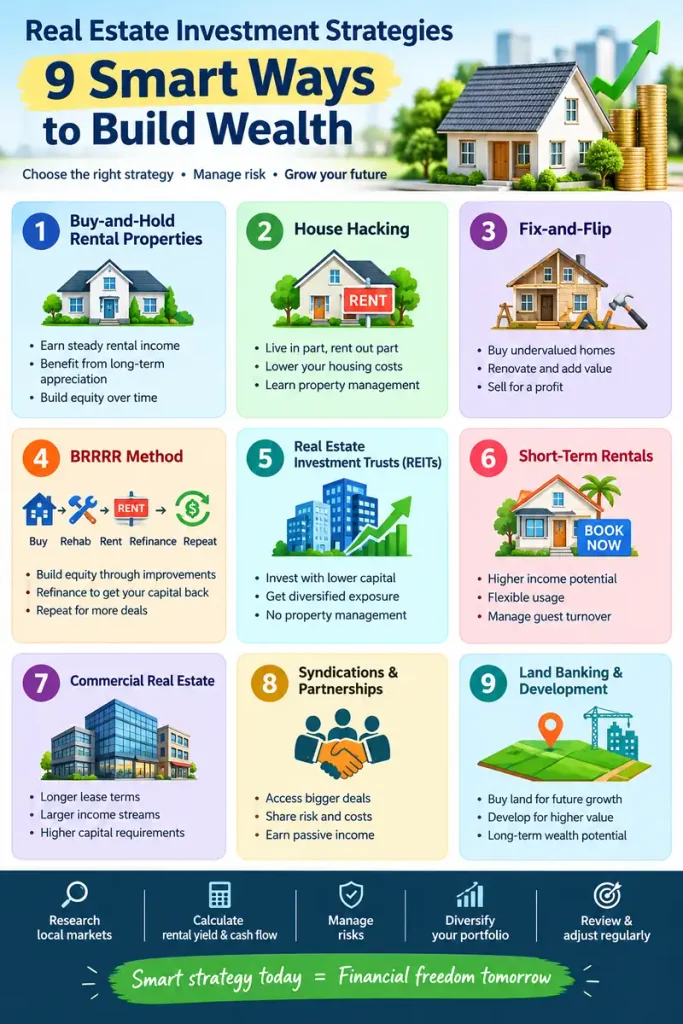
1. Buy-and-Hold Rental Properties
Buy-and-hold investing involves purchasing a property and keeping it for several years while generating rental income. Investors may also benefit from property appreciation, although prices can decline as well as rise.
Potential advantages include:
- Recurring rental income.
- Possible long-term capital appreciation.
- Gradual mortgage principal repayment when financed.
- Opportunities to improve rental income through effective management.
Example: Suppose you purchase a rental property for $180,000. It generates $18,000 in annual rent, with $7,000 in annual operating expenses excluding mortgage payments.
Your annual net operating income (NOI) is:
$18,000-$7,000=$11,000
The capitalization rate, or cap rate, is:
$11,000\$180,000 x times100=6.11%
This 6.11% cap rate measures the property’s operating income relative to its purchase price. It is not your final investment return because it excludes financing costs, income taxes, and certain other expenses.
2. House Hacking
House hacking means living in a property while renting out part of it. Depending on local laws and the property’s layout, you might rent a spare bedroom, a separate apartment, or another permitted living space.
This approach can help reduce personal housing expenses while introducing you to property management.
Example: Your monthly mortgage and other housing costs total $1,600. A legally rentable room generates $650 monthly.
Your effective housing cost becomes $950 per month before additional expenses associated with the rental.
The main challenges include privacy, tenant screening, insurance requirements, and compliance with local rental regulations.
3. Fix-and-Flip Investing
Property flipping involves purchasing a property, renovating it, and selling it for more than the total acquisition and project costs.
Successful flipping depends on accurate renovation estimates, purchase discipline, contractor management, and realistic resale values.
Illustrative example:
| Item | Amount |
|---|---|
| Purchase price | $150,000 |
| Renovation | $25,000 |
| Financing, holding and transaction costs | $15,000 |
| Total investment cost | $190,000 |
| Resale price | $215,000 |
| Estimated pre-tax profit | $25,000 |
The $25,000 difference is a projected profit before any omitted costs or applicable taxes. If renovations run over budget or the property sells for less than expected, the profit may shrink or become a loss.
Before purchasing, compare recent sales of similar properties and obtain reliable repair estimates.
4. The BRRRR Method
BRRRR stands for Buy, Rehab, Rent, Refinance, Repeat. Investors purchase a property, improve it, find tenants, refinance when eligible, and use released capital toward another investment.
This strategy can help investors recycle capital, but it depends on financing availability and the property’s value after renovation.
Example: An investor purchases a distressed property for $100,000 and spends $25,000 on repairs. If the improved property is valued at $170,000, a lender might consider refinancing it based on its valuation, lending criteria, and the investor’s financial position.
However, the investor should not assume that all invested capital can be recovered. Appraisal results, loan-to-value limits, interest rates, closing fees, and rental performance can change the outcome.
5. Real Estate Investment Trusts (REITs)
REITs allow investors to gain exposure to income-producing real estate through a company or trust that owns or finances property-related assets. Publicly traded REITs can be purchased through a brokerage account, subject to availability and local rules.
Potential benefits include:
- Lower entry costs than buying a building directly.
- Access to diversified property portfolios.
- No need to manage tenants personally.
- Easier trading for listed REITs than for physical property, although market liquidity varies.
REITs also carry risks, including interest-rate sensitivity, property-market downturns, debt exposure, and changes in share prices. Private and non-traded REITs may have substantial liquidity restrictions and fees.
6. Short-Term Rental Investing
Short-term rentals provide accommodation to visitors for brief stays. Income can sometimes exceed long-term rental income, but the business may require more active management.
Important expenses include cleaning, utilities, furnishing, guest communication, platform fees, insurance, and periods without bookings.
Before investing, confirm that local zoning rules, building regulations, landlord or community restrictions, and licensing requirements permit short-term accommodation.
Evaluate conservative occupancy assumptions rather than basing your decision on peak-season revenue alone.
7. Commercial Real Estate Investing
Commercial properties include offices, retail units, industrial buildings, warehouses, and other properties used by businesses.
These investments may offer longer leases and opportunities for larger income streams. However, they can require substantial capital and involve tenant concentration, expensive repairs, financing challenges, and sensitivity to economic conditions.
Example: An investor evaluating a retail unit should examine its location, lease terms, tenant financial strength, vacancy trends, maintenance responsibilities, and comparable rental rates.
A high advertised rental yield is not enough if the property remains vacant or requires major repairs.
8. Real Estate Syndications and Partnerships
A real estate syndication pools capital from multiple investors to acquire or operate a property. A sponsor or manager typically handles the project, while investors receive returns according to the agreement.
Partnerships may help investors access larger properties without managing every aspect themselves.
Before committing money, review the sponsor’s track record, fees, ownership rights, debt structure, distribution rules, exit provisions, and conflicts of interest. Some investments have limited liquidity and can lose substantial value.
Understand the legal structure and seek independent professional advice where necessary.
9. Land Banking and Property Development
Land banking involves purchasing land in anticipation of future demand or development. Property development goes further by constructing or substantially improving buildings.
These approaches may generate significant gains, but neither guarantees appreciation.
Land can produce little or no income while still generating taxes, security costs, financing charges, and other expenses. Development also involves planning approvals, infrastructure, contractor performance, environmental considerations, and construction risk.
Before buying land, verify legal title, permitted uses, access, utilities, planning restrictions, and realistic resale demand.
Comparing the Best Property Investment Strategies
The following table provides a practical starting point. Capital requirements and risk levels are relative assessments, not universal market statistics.
| Strategy | Capital requirement | Time commitment | Main return source |
|---|---|---|---|
| Buy-and-hold rentals | Medium–high | Medium | Rent and appreciation |
| House hacking | Low–medium relative to buying a property | Medium | Rent that offsets housing costs |
| Fix-and-flip | Medium–high | High | Renovation and resale profit |
| BRRRR | Medium–high | High | Rent, refinancing and repeat acquisitions |
| REITs | Low–medium | Low | Distributions and share-price changes |
| Short-term rentals | Medium–high | High | Guest bookings |
| Commercial property | High | Medium–high | Lease income and appreciation |
| Syndications | Varies by offering | Low–medium | Distributions and exit proceeds |
| Land banking/development | Medium–very high | Medium–high | Land appreciation or development profit |
How to Choose a Real Estate Investment Strategy?
The most effective strategy is the one that matches your finances and investment objectives.
Step 1: Define your investment goal
Decide whether you want recurring income, long-term wealth accumulation, active business profits, or property-market exposure without direct management.
Step 2: Calculate your available capital
Include the deposit or purchase price, transaction costs, renovations, initial repairs, financing expenses, and an emergency reserve.
Do not invest all your available savings in the acquisition itself.
Step 3: Research the local market
Examine comparable sale prices, realistic rents, vacancy rates, employment trends, local development plans, property taxes, and rental regulations.
Local data is more useful than assuming that a national property trend applies to every neighborhood.
Step 4: Calculate the numbers
For rental property, estimate:
- Gross annual rental income.
- Vacancy and unpaid rent.
- Property management fees.
- Maintenance and capital expenditure.
- Insurance and property taxes.
- Mortgage payments and other financing costs.
- Expected cash flow after expenses.
Stress-test the numbers by reducing expected rent, increasing expenses, or allowing for a longer vacancy.
Step 5: Complete due diligence
Verify title and ownership, inspect the property, review relevant contracts, check permitted use, obtain insurance estimates, and confirm financing conditions.
For partnerships or pooled investments, investigate the manager and examine the full legal documents before investing.
How to Measure Property Investment Performance?
Investors should compare multiple metrics instead of relying on one attractive percentage.
| Metric | Formula | What it tells you |
|---|---|---|
| Gross rental yield | Annual rent ÷ property price × 100 | Rent relative to purchase price |
| Cap rate | Annual NOI ÷ property value × 100 | Operating income before financing |
| Cash flow | Income received minus cash expenses | Money left after expenses |
| Cash-on-cash return | Annual pre-tax cash flow ÷ cash invested × 100 | Cash income relative to invested cash |
| Total return | Income plus change in value, adjusted for costs, relative to investment | Overall investment performance over a defined period |
Example: If you invest $50,000 in cash and the property produces $4,000 in annual pre-tax cash flow after operating expenses and debt payments, your cash-on-cash return is:
$4,000\$50,000 x 100=8%
This calculation excludes potential appreciation and changes in the property’s equity. For meaningful comparisons, use consistent assumptions and account for transaction costs and the time value of money when evaluating multi-year investments.
Major Real Estate Investment Risks and How to Reduce Them
Every strategy has risks. A sound investment plan identifies those risks before money is committed.
| Risk | Mitigation |
|---|---|
| Vacancy or unpaid rent | Use conservative occupancy assumptions and screen tenants lawfully |
| Unexpected repairs | Arrange inspections and maintain a contingency reserve |
| Rising interest rates | Stress-test financing and review fixed versus variable rates |
| Declining property values | Avoid relying on appreciation alone |
| Legal or title disputes | Verify ownership, title records and applicable laws |
| Poor cash flow | Model all operating and financing expenses |
| Illiquidity | Keep emergency funds outside the investment and understand exit restrictions |
| Contractor or partner failure | Check references, contracts, credentials and financial arrangements |
Diversification can reduce concentration risk, but it cannot eliminate losses. Investors should also avoid excessive borrowing and understand the consequences of being unable to meet loan payments.
Author’s Thoughts: What Makes a Strategy Worth Pursuing?
In my view, the best real estate investment strategy is not necessarily the one with the highest projected return. It is the one that can withstand realistic setbacks without jeopardizing the investor’s financial stability.
A property that appears profitable under perfect conditions may become a poor investment after a major repair, several months of vacancy, or an increase in financing costs. A less exciting investment with stronger cash flow and a manageable debt burden may be more appropriate for a beginner.
I also believe investors should separate buying a good property from buying at a good price. A well-maintained building can still be a poor investment if the purchase price is too high. Conversely, a discounted property may remain unattractive if legal problems, repairs, or weak rental demand outweigh the discount.
Use calculations to test your assumptions, verify important facts independently, and make decisions based on your own circumstances rather than someone else’s success story.
Conclusion: Build a Strategy Before Buying Property
Real estate can provide rental income, appreciation, and portfolio diversification, but successful investing requires more than identifying an attractive property. It requires a clear objective, realistic financial calculations, market research, careful due diligence, and a plan for managing risk.
Start by comparing the nine strategies in this guide. Select one that matches your capital and available time, evaluate several potential investments, and test whether the numbers remain viable under less favorable conditions.
My recommendation: Beginners should prioritize understanding cash flow, financing, and due diligence before pursuing complex strategies such as property flipping, BRRRR, or development. Consider REITs if you want property exposure without directly managing buildings. Regardless of your approach, never rely solely on expected appreciation or a seller’s projected returns.
Real estate investment strategies work best when they are supported by verified information, disciplined financial planning, and realistic expectations.
FAQs About Real Estate Investment Strategies
1. What is the best real estate investment strategy for beginners?
Buy-and-hold rentals, house hacking, and publicly traded REITs are common starting points to research. The right choice depends on your capital, risk tolerance, financing access, and desired level of involvement.
2. Can I invest in real estate with little money?
Potentially. REITs can offer relatively low-cost exposure to real estate, while certain partnerships or financing arrangements may lower the initial cash requirement for direct ownership. However, borrowing introduces risk, and minimum investments and eligibility requirements vary.
3. Is rental property better than REITs?
Neither is always better. Direct rentals provide more control but require property management and substantial capital. REITs can offer easier diversification and, for listed funds, greater liquidity, but their market prices fluctuate.
4. What is the BRRRR method in real estate?
BRRRR means Buy, Rehab, Rent, Refinance, Repeat. Investors acquire and improve a property, rent it out, and refinance when eligible to potentially reuse part of their capital. The method depends on property valuation, lending terms, and sustainable rental income.
5. How do I calculate rental property profitability?
Begin with rental income and subtract vacancy losses and operating expenses to calculate net operating income. Then account for mortgage payments and other cash expenses to estimate cash flow. Use cap rate and cash-on-cash return to compare suitable investments.
6. Is flipping houses a good investment?
It can be profitable for investors who understand renovation costs, resale demand, project management, and financing. However, overruns, delays, market declines, and unexpected repairs can eliminate projected profits.
7. What is a good rental property cap rate?
There is no universally good cap rate. Appropriate returns depend on location, property condition, tenant risk, financing environment, and expected future expenses. Compare similar properties in the same market using consistent calculations.
8. Is real estate a safe long-term investment?
Real estate can be part of a long-term investment plan, but it is not risk-free. Property values can fall, tenants may stop paying, repairs can be expensive, and debt obligations continue even when rental income declines.
9. Should I invest in residential or commercial real estate?
Residential property may be more familiar to beginners, while commercial investments can offer different lease structures and income opportunities. Compare purchase costs, tenant demand, financing, vacancy risk, management requirements, and local market conditions.